

Football CSS Templates
Football scoreboards, player cards, and fixture grids require more than standard styling. These CSS templates help clubs apply recognizable team colors, adapt sports layouts to mobile devices, and fine-tune individual components with targeted style rules.












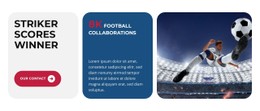



More Website & HTML Templates for Football










More CSS Templates from Sports Category

Other Sports CSS Templates
Customizable Football CSS Templates for Sports Websites
Football CSS templates are useful when a club needs styled match components it can adapt to its own identity. A vibrant shirt color may work well on a large banner but fail behind a small score label. A suitable CSS-based design should provide editable rules for contrast, spacing, grids, and responsive behavior rather than rely on decorative effects alone.
Football Scoreboards with Clear CSS Styling
Supporters scan team names and final scores. CSS backgrounds, borders, padding, and type styles can distinguish a finished match from an upcoming fixture without relying on color alone. Keep club badges in consistent containers so unusually wide or tall logos do not distort the scoreboard.
CSS Grid can arrange multiple fixture cards across a page; Flexbox works well inside a card to align a badge, team name, and score even when names have different lengths. When evaluating a football CSS template, check whether these components are already styled coherently and can be adjusted without rewriting the entire layout.
Consistent Club Colors and Player Card Layouts
Nicepage Theme Colors provide shared design settings. Apply the club's real palette to scoreboard labels and buttons, then check whether the text stays readable against saturated backgrounds. Player cards also need consistent image proportions and room for long surnames. For a different match-status badge or squad-card variation, Custom CSS can target the relevant element, page, or site styles.
Responsive CSS for Football Fixtures and League Tables
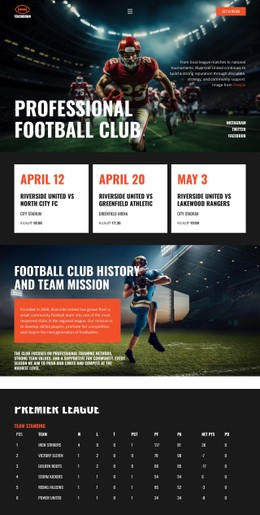
A desktop fixture grid might show several matches per row, whereas a phone layout should move to one column through suitable media queries. League tables require a more deliberate choice: preserve rank, team, and points where possible and allow secondary statistics to scroll horizontally if needed. Shrinking every column usually makes the data harder to use.
Before selecting a CSS template for a real football site, review the following component behavior:
- Grid and spacing: Check that fixture cards reflow cleanly under media queries on narrow screens.
- Contrast: Test scores, status badges, and controls against the actual club palette.
- Team names and badges: Confirm long names wrap while logo containers keep their proportions.
- League tables: Make rankings and points readable without crushing all columns together.
- Focus styles: Ensure keyboard navigation remains visible on links and interactive controls.
A design with usable defaults for scoreboards, player cards, and competition tables will require less custom styling than a generic sports page, even if both look attractive in a preview.