
Services HTML Templates
Service businesses often need separate sections for consultations, repairs, maintenance, or other offerings. These HTML templates provide structured layouts for service descriptions, prices, and contact details, with reusable markup that adapts to different screen sizes.










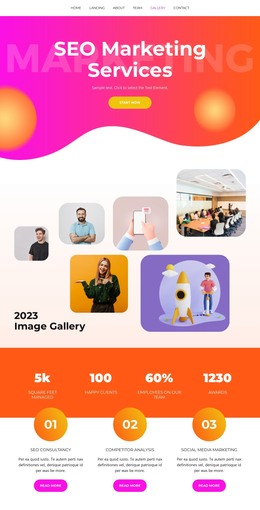


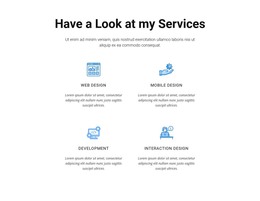





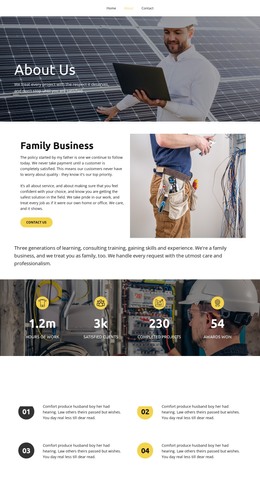
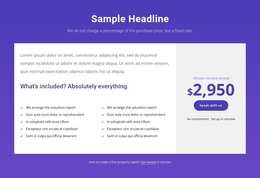













































Other Business & Law HTML Templates
Responsive Services HTML Templates for Business Websites
Services HTML templates give agencies, contractors, consultants, and local businesses a ready-made structure for presenting their professional offerings online. A repair company may need separate descriptions for diagnostics and maintenance, while a consulting firm requires clear distinctions between advisory packages. HTML headings, semantic sections, and links give each offering a recognizable place in the document structure, independently of the colors or spacing applied through styling. The result is a practical foundation that supports readable content, consistent presentation, and future service updates.
Clean HTML Structure for Multiple Services
Four HTML details help visitors understand how services are organized:
- Section headings identify distinct service categories.
- Subheadings distinguish individual offerings from their supporting details.
- Descriptive links connect the service to its relevant inquiry destination.
- Related content stays inside a clearly identified section.
A service website must help visitors distinguish between offerings without unnecessary navigation. Ready-made HTML layouts provide individual content areas for service titles, short descriptions, supporting images, and relevant business information.
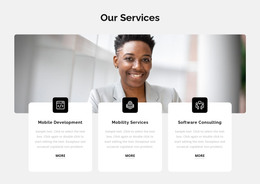
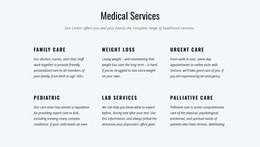
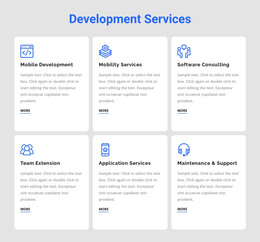
For example, a maintenance company can present plumbing, electrical repairs, and scheduled inspections in separate cards. A marketing agency can use the same structural approach for SEO audits, content strategy, and advertising management. Each service remains identifiable through its own heading and description. When choosing a ready-made HTML template, compare its service-card layout with your actual offerings, then replace sample content and adjust the sections to match your prices and inquiry options.
When assessing a more detailed HTML template, check whether each service has room for the information it actually needs:
- A specific service title rather than an ambiguous label.
- A description covering what is included in the offering.
- An optional image with appropriate alternative text.
- A price, price range, or explanation of quotation requirements.
- A direct contact or request link associated with that service.
- A predictable order of these elements across repeated offerings.
Together, these elements make each service easier to locate and update without disturbing unrelated content.
Ready-to-Use HTML Sections for Responsive Service Pages
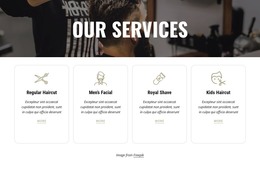
Professional services HTML templates should accommodate different amounts of content without disrupting the page hierarchy. A legal consultancy may require detailed descriptions of advisory areas, while a barbershop can present shorter service names, appointment durations, and prices.
For repeated offerings, Nicepage provides the Grid Repeater Element, a visual editor element for arranging similarly styled items. Designers can use it to build service cards with different descriptions and images; it does not itself create a dynamic service-management system or a separate native HTML component.
Responsive markup is equally important. On a desktop screen, several service cards may appear in columns. On a smartphone, those same items should remain readable in a vertical arrangement, with clear headings and accessible contact links.
Nicepage also supports HTML website export with the associated CSS, JavaScript, and image files. Businesses can therefore prepare their service pages for publication on compatible external hosting.
The clearest test of a services HTML template is whether its document structure remains understandable when the styling is set aside: headings identify each offering, related details stay together, and inquiry links have an unambiguous destination. That foundation makes later content changes easier to review.