
Arabic Landing Pages
When an Arabic campaign has one clear goal, the page should keep the offer, supporting proof, and response path easy to follow. A focused landing-page structure helps the message lead naturally toward one primary action.
More Landing Pages from Landing Page Category









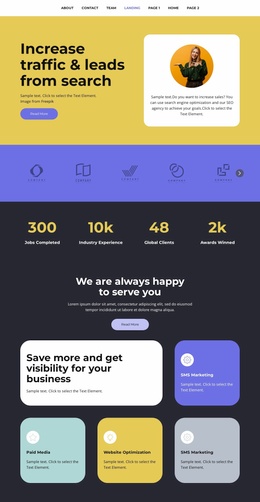
Other Landing Page Landing Pages
Responsive Arabic Landing Page Templates
A dental clinic in Jeddah runs a two-week promotion. A software company opens registration for an Arabic webinar. Each campaign lives on a single page whose whole job is to explain one offer and collect one response. Arabic landing page templates are built around that job, which is why they carry far less than a company website.
Anchor the Design to a Single Offer
The offer decides what earns space. A consultation campaign ends with a booking request, an event promotion with registration, and a product launch with a signup form. Everything above that point exists to make the step look reasonable.
A conversion sequence for an Arabic campaign usually holds four parts:
- a headline that states the offer at first reading;
- a short value block written for the audience the ad set targets;
- proof such as testimonials, project photos, or client logos;
- one call to action with a form short enough to finish in one sitting.
Sections outside that sequence quietly compete with the response the campaign paid for.
How RTL Reading Changes Block Order
An Arabic page is read from right to left, so mirroring a template moves more than just the text. The eye enters at the top-right corner, which changes where the headline, the hero image, and the button feel natural. A layout designed around an English reading path often leaves the call to action in the corner an Arabic visitor checks last.
Length is the second correction. The same sentence in Arabic often comes out shorter than its English source, and a hero band built for a long English line looks half-empty. Longer Arabic headlines do the opposite and wrap to another line, pushing the form below the first screen. Latin fragments keep their own direction inside Arabic copy, so brand names and model numbers are worth checking in the live layout before the ads go out.
Phone Traffic, Short Forms
Paid Arabic traffic arrives mostly from social feeds on phones, where a desktop composition turns into a long scroll, and every extra field becomes a reason to leave. The form is the first place to cut. A name and a phone number carry a callback campaign, and the qualifying questions can wait for the call.
Nicepage edits the layout in separate responsive modes, and phones get two of their own, horizontal and vertical, so the offer and the button can be rearranged for a narrow screen without touching the desktop version.
After launch, the ad account reports what no layout review catches: where visitors stop scrolling and which field ends the form.