We make sending flowers fun Landing Page

Edit Template Offline
2. Create new page and search for id 6268465
Edit Template Online
Create Awesome Websites


Free Nicepage Builder
Keywords
From Floral Discovery to a Mailing-List Response
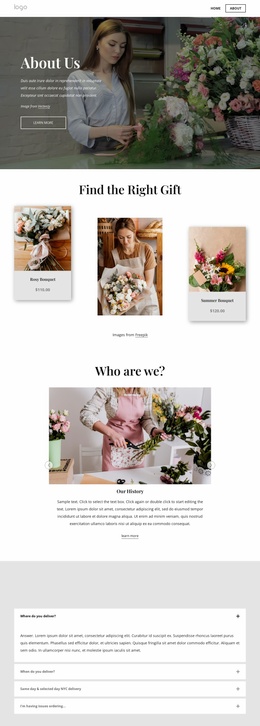
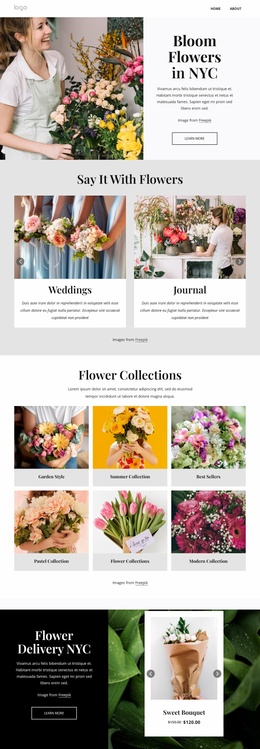
The page opens with a direct Flower Delivery message over a darkened floral image, followed by Best Sellers and Shop Now actions. That opening gives the visitor both a subject and an immediate response option before the page moves into supporting reasons. The four feature items—freshest flowers, value for money, quick delivery, and greeting cards—can answer practical questions that might otherwise interrupt the path from initial interest to action.
Visual proof and service breadth appear in the middle of the sequence. Six Flower Collections categories let the offer be understood through distinct image-led choices, while the three Event Florals cards extend the subject to Events, Weddings, and Workshops. The testimonial carousel adds customer-oriented reassurance, and the nine-image gallery shows the arrangement focus through a larger visual set. The NYC introduction and four florist-related team profiles add local and human context without replacing the main floral message.
The five FAQ rows provide a place for common objections before the final response area. Near the bottom, the compact mailing-list form asks for a name and includes a Submit action under the heading “Join Our Mailing List for Discounts & More!” Nicepage documents the Contact Form Element as a way to build responsive forms; here, its relevant role is the final signup point in an already established action sequence, not a reason to add unrelated form mechanics.
Customize with Nicepage
Open this ready-made template in the Landing Page Builder and customize it visually in the Nicepage editor. Replace demo content, edit page sections, and adapt the design to your project without rebuilding the template from scratch.
Build a Landing Page Around One Conversion Goal
Focus on One Primary Action
Use the landing page to guide visitors toward one measurable response, such as requesting a quote, registering, subscribing, booking a consultation, applying for a service, or submitting an inquiry. Keep the primary call-to-action consistent across the important sections so the headline, supporting content, form, and CTA buttons work toward the same campaign goal instead of competing for attention.
Capture Leads With a Form
Use the Contact Form Element to add a contact, subscription, application, or other conversion form directly to the landing page. Customize the form fields, layout, labels, inputs, and button to collect the information required for your campaign while keeping the form focused on the action you want visitors to complete.
Nicepage also provides several form submission options. Form submissions can be sent to Email, stored as Leads, added to Google Sheets, passed to a custom URL or server endpoint, or used to populate a MailChimp mailing list. This provides practical options for collecting inquiries, registrations, subscriptions, applications, and other campaign responses.
Manage Leads and Campaign Responses
When submissions are stored as Leads, you can use Contact Form Leads to review the information collected through the landing page and use it for follow-up. Keep the form connected to the same offer and primary CTA presented throughout the page so visitors move from the campaign message to a clear conversion action.
This workflow makes the template suitable for landing pages where the offer, content, call-to-action, form, and lead collection process work together toward one defined conversion goal.

More from Fashion & Beauty Landing Pages
-
Free Website Builder SoftwareDownload