Burger menu Template


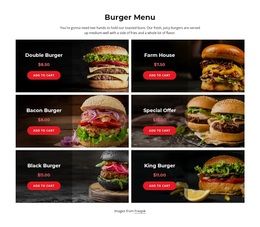
A Compact Menu Design Balances Choices and Product Imagery
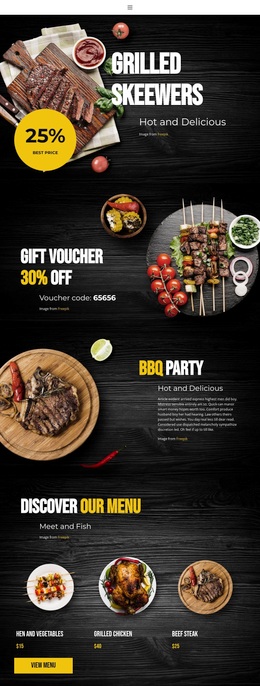
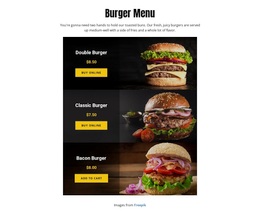
The centered Burger Menu introduction leads into three horizontal product cards rather than a broad grid or a single featured item. Bacon Burger, Classic Burger, and Double Burger each receive a dedicated row with product information on the left, burger imagery on the right, a displayed price, and an Add to Cart action. That combination gives the design enough content coverage for a compact menu while keeping each choice visually separate.
The dark cards create a strong frame for the food imagery, and the yellow prices and buttons provide a repeated decision cue across the stack. Consistent spacing prevents the three products from merging into one dense panel, while the white background and black uppercase heading keep the opening comparatively restrained. These characteristics make the block a useful design option when a page needs several menu choices with more visual presence than plain text rows but less breadth than a large catalog grid. The design’s value comes from how its repeated product structure, image emphasis, and direct actions work together. It is a ready-made section choice for a focused burger offering, not a complete ordering experience.
Customize with Nicepage
Open this ready-made template in the Template Builder and customize it visually in the Nicepage editor. Replace demo content, edit page sections, and adapt the design to your project without rebuilding the template from scratch.
Edit Template Offline
2. Create a new page or select existing
3. Click Add new block, search for id 5805552 and click enter
Edit Template Online
Create Awesome Websites


Free Nicepage Builder
Keywords
Start With a Ready-Made Template
Choose a Design for a New Page
Use a ready-made template as a starting point instead of creating every page from a blank canvas. When adding a new page in Nicepage, browse available designs, compare different layouts, and choose an option that already fits the general purpose and visual direction of your project.
Browse Different Page Designs
Explore Page Designs using search, thematic categories, Design Sets, and full-page previews. The collection includes layouts for different subjects and page purposes, making it easier to compare alternatives before selecting a design to customize.
Customize the Selected Template
After choosing a design, create the page and continue editing it visually in Nicepage. Replace the demo content, adjust images, typography, colors, sections, and other elements, and adapt the ready-made layout to your own content instead of rebuilding the design from the beginning.
Explore More Design Directions
If the first option does not match your project closely enough, return to the design collection and compare other templates before committing to a layout. This makes the template library useful not only for faster page creation, but also for exploring different visual approaches and finding a suitable starting point for a new project.
This workflow gives you access to a broad collection of ready-made designs that can be selected, compared, and customized according to the needs of each new page or project.