Hard roads of industiral Template


Edit Template Offline
2. Create new page and search for id 17580
Edit Template Online
Create Awesome Websites


Free Nicepage Builder
Keywords
Cargo Routes, Human Proof, and Practical Coverage
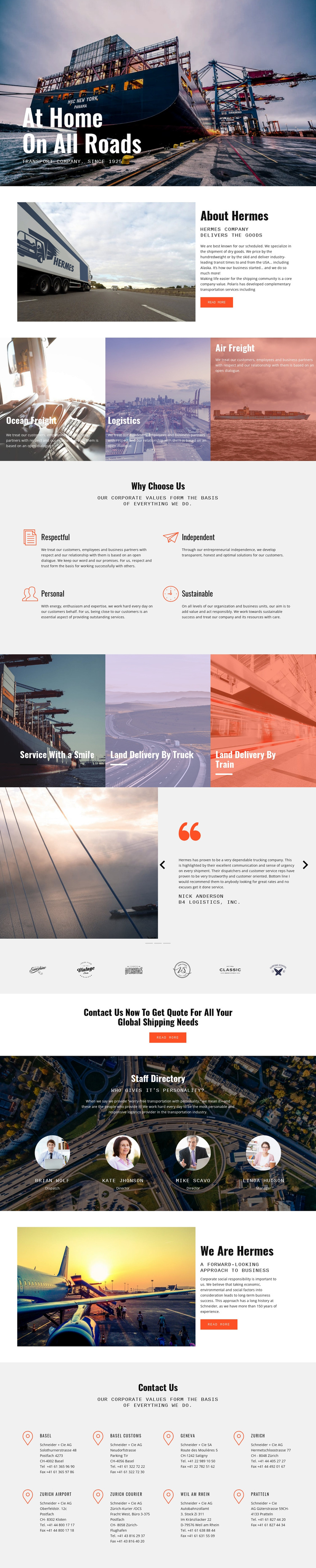
The combination of port, road, aircraft, truck, and rail imagery makes freight movement the central visual subject rather than a secondary decoration. Three service tiles identify Ocean Freight, Logistics, and Air Freight, while the later delivery panels focus on truck and train transport. This gives the design a useful range for projects that need to show several logistics modes without relying on a dense list of technical specifications.
The page also balances operational content with human and organizational evidence. Four stated values—Respectful, Independent, Personal, and Sustainable—explain the company character, while three testimonial entries and a row of partner or client marks introduce supporting proof. Four staff profiles add recognizable people to a design otherwise dominated by infrastructure and vehicles. The two About Hermes narratives help connect these separate areas into a company story.
The design is particularly distinguishable through its closing coverage. A quote-oriented callout addresses global shipping needs, and the final contact region names offices and service points including Basel, Geneva, Zurich, Zurich Airport, Zurich Courier, Weil am Rhein, and Pratteln. That combination makes the template a practical option for a logistics presentation that must communicate transport scope, company values, personnel, and regional availability in one strong visual direction.
Customize with Nicepage
Open this ready-made template in the Template Builder and customize it visually in the Nicepage editor. Replace demo content, edit page sections, and adapt the design to your project without rebuilding the template from scratch.
Start With a Ready-Made Template
Choose a Design for a New Page
Use a ready-made template as a starting point instead of creating every page from a blank canvas. When adding a new page in Nicepage, browse available designs, compare different layouts, and choose an option that already fits the general purpose and visual direction of your project.
Browse Different Page Designs
Explore Page Designs using search, thematic categories, Design Sets, and full-page previews. The collection includes layouts for different subjects and page purposes, making it easier to compare alternatives before selecting a design to customize.
Customize the Selected Template
After choosing a design, create the page and continue editing it visually in Nicepage. Replace the demo content, adjust images, typography, colors, sections, and other elements, and adapt the ready-made layout to your own content instead of rebuilding the design from the beginning.
Explore More Design Directions
If the first option does not match your project closely enough, return to the design collection and compare other templates before committing to a layout. This makes the template library useful not only for faster page creation, but also for exploring different visual approaches and finding a suitable starting point for a new project.
This workflow gives you access to a broad collection of ready-made designs that can be selected, compared, and customized according to the needs of each new page or project.