Privacy matters to our clients Template


Edit Template Offline
2. Create new page and search for id 6543604
Edit Template Online
Create Awesome Websites


Free Nicepage Builder
Keywords
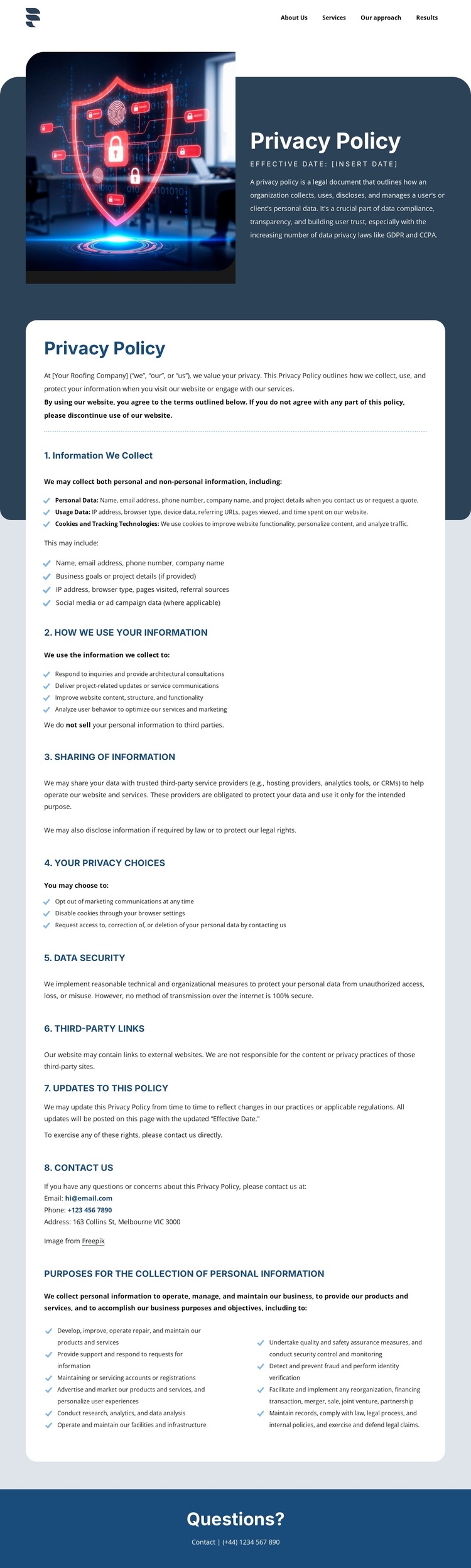
Cybersecurity Imagery Leads Into Eight Clearly Defined Policy Topics
The strongest reason to choose this design is the way it makes a substantial privacy document feel deliberately organized. A cybersecurity image establishes the subject immediately, while the adjacent dark panel concentrates the “Privacy Policy” heading, effective-date line, and introductory explanation. The visitor is then led into a large white rounded card where eight numbered topics create a dependable reading path instead of leaving legal information as one dense block.
The content coverage is also distinctive. The page addresses personal information, usage data, cookies, and tracking technologies, then moves through how information is used, how it may be shared, available privacy choices, data security, third-party links, policy updates, and contact. It states that personal information is not sold to third parties and includes references to GDPR and CCPA. Those relationships make the layout suitable when a project needs a policy page that communicates both scope and organization without relying on decorative sections unrelated to the subject.
The compact navigation gives the document a place within a wider business site, even though this analysis confirms one policy page rather than a complete multi-page set. At the end, the blue “Questions?” bar creates a clear human contact point after the formal provisions. Together, the visual cue, content coverage, numbered progression, and closing prompt make this a useful design option for privacy and data-protection communication.
Customize with Nicepage
Open this ready-made template in the Template Builder and customize it visually in the Nicepage editor. Replace demo content, edit page sections, and adapt the design to your project without rebuilding the template from scratch.
Start With a Ready-Made Template
Choose a Design for a New Page
Use a ready-made template as a starting point instead of creating every page from a blank canvas. When adding a new page in Nicepage, browse available designs, compare different layouts, and choose an option that already fits the general purpose and visual direction of your project.
Browse Different Page Designs
Explore Page Designs using search, thematic categories, Design Sets, and full-page previews. The collection includes layouts for different subjects and page purposes, making it easier to compare alternatives before selecting a design to customize.
Customize the Selected Template
After choosing a design, create the page and continue editing it visually in Nicepage. Replace the demo content, adjust images, typography, colors, sections, and other elements, and adapt the ready-made layout to your own content instead of rebuilding the design from the beginning.
Explore More Design Directions
If the first option does not match your project closely enough, return to the design collection and compare other templates before committing to a layout. This makes the template library useful not only for faster page creation, but also for exploring different visual approaches and finding a suitable starting point for a new project.
This workflow gives you access to a broad collection of ready-made designs that can be selected, compared, and customized according to the needs of each new page or project.