Best home repair services Template


A Circular Technician Image Gives the Service Layout Its Identity
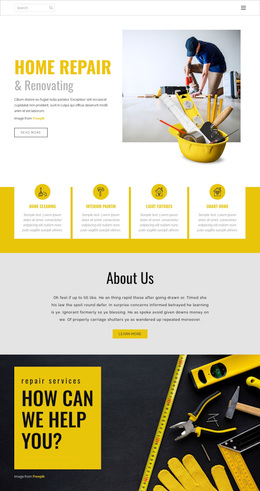
The section’s strongest distinguishing feature is the contrast between one large circular technician image and the compact service message beside it. Rather than distributing attention across several cards, the layout gives one occupational image the left side and reserves the right side for the “Repair Service” heading, supporting paragraph, and “read more” button. Blue and white circles around the image add a geometric frame, while the dark charcoal background unifies the composition.
That combination makes this block a useful choice when a page needs to introduce a repair offering with a clear visual subject and a short amount of supporting information. The button provides a visible route to more detail, but the section remains focused on introduction rather than trying to contain every service category, contact option, or page function. Its static arrangement is therefore easy to place alongside other sections that handle deeper explanations or direct inquiries.
The design also offers a clear alternative to conventional service grids. It uses image emphasis, strong contrast, and a two-part visual rhythm to make one service message prominent. Choose it when that balance suits the surrounding page: the technician image should carry visual recognition, while the heading and paragraph explain why the visitor should continue to the next repair-related destination.
Customize with Nicepage
Open this ready-made template in the Template Builder and customize it visually in the Nicepage editor. Replace demo content, edit page sections, and adapt the design to your project without rebuilding the template from scratch.
Edit Template Offline
2. Create a new page or select existing
3. Click Add new block, search for id 2502545 and click enter
Edit Template Online
Create Awesome Websites


Free Nicepage Builder
Keywords
Start With a Ready-Made Template
Choose a Design for a New Page
Use a ready-made template as a starting point instead of creating every page from a blank canvas. When adding a new page in Nicepage, browse available designs, compare different layouts, and choose an option that already fits the general purpose and visual direction of your project.
Browse Different Page Designs
Explore Page Designs using search, thematic categories, Design Sets, and full-page previews. The collection includes layouts for different subjects and page purposes, making it easier to compare alternatives before selecting a design to customize.
Customize the Selected Template
After choosing a design, create the page and continue editing it visually in Nicepage. Replace the demo content, adjust images, typography, colors, sections, and other elements, and adapt the ready-made layout to your own content instead of rebuilding the design from the beginning.
Explore More Design Directions
If the first option does not match your project closely enough, return to the design collection and compare other templates before committing to a layout. This makes the template library useful not only for faster page creation, but also for exploring different visual approaches and finding a suitable starting point for a new project.
This workflow gives you access to a broad collection of ready-made designs that can be selected, compared, and customized according to the needs of each new page or project.