Contacts with big icons WordPress Theme


Stable Contact Content for a WordPress-Managed Page
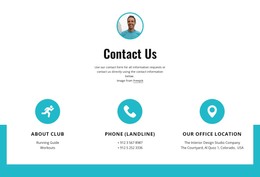
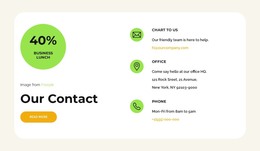
The block reads as permanent contact information rather than a time-sensitive list of posts. Its centered portrait, Contact Us heading, and supporting paragraph introduce a stable page section, while the three cards divide the content into clear publishable areas. About Club supplies broader context, Phone (Landline) contains two number entries, and Our Office Location combines a company line with a location line. The circular icons make those areas easy to distinguish without adding interaction.
Within a WordPress-oriented project, this section can remain part of a stable contact or information page while other CMS-managed content develops around it. The block itself keeps its own visual and content role: a white central panel contains the composition, turquoise accents connect the cards, and bold headings establish a readable hierarchy. If the surrounding page is updated, the three-card structure can still preserve the same relationship between general context and direct contact details. This makes the section useful as reusable page content without turning it into a complete theme or implying that specific WordPress content types are already inside the block.
Customize with Nicepage
Open this ready-made template in the WordPress Website Builder and customize it visually in the Nicepage editor. Replace demo content, edit page sections, and adapt the design to your project without rebuilding the template from scratch.
Edit Template Offline
2. Create a new page or select existing
3. Click Add new block, search for id 2981985 and click enter
Edit Template Online
Create Awesome Websites


Free Nicepage Builder
Keywords
Use This Block in a WordPress-Managed Website
Keep the Block as Page Content
Use the block as one content/layout section inside a WordPress-oriented site rather than treating the Block ID as a complete WordPress Theme. Its verified text, images, repeated items, forms, galleries, or other elements can remain part of permanent page content while WordPress manages the wider site.
Work With Nicepage and WordPress
A Nicepage WordPress project can be installed using the WordPress Theme, Plugin, and Pages workflow. After installation, the same visual section can participate in WordPress-managed pages as part of the broader theme/site structure.
Continue Editing in WordPress
Nicepage supports editing the WordPress Theme directly in WordPress. Use WordPress Pages, Posts, Blog structures, and other CMS concepts only when they are relevant to the surrounding project; their existence must not be inferred from the analyzed block alone.
This workflow keeps the block's verified section function separate from the WordPress theme architecture while allowing it to participate in a CMS-managed website.