A corporate history Template


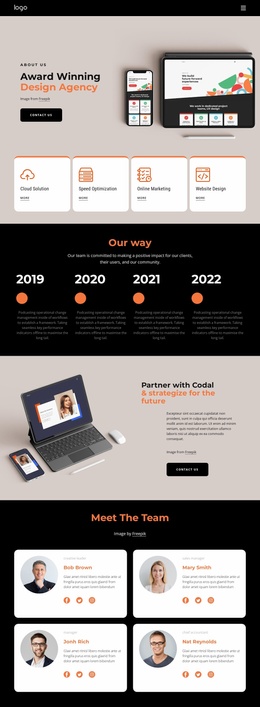
Four Dated Milestones Give This Section a Distinctive Direction
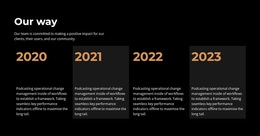
The centered “Our way” heading and supporting paragraph establish a clear introduction, but the defining choice is the four-stage timeline beneath it. Years 2019, 2020, 2021, and 2022 appear in sequence across one horizontal row, each connected to an orange circular marker and a descriptive paragraph. This arrangement communicates progression more directly than a conventional group of unrelated text columns because the repeated markers and year labels create an immediate chronological reading path.
The design is also distinctive in how it combines a dark visual field with restrained information hierarchy. The black background gives the section visual weight, while white typography keeps the heading and year labels prominent. Muted gray descriptions provide supporting detail without competing with the orange accents or the evenly spaced milestone positions. The result is a compact history option for a page that needs visible structure without relying on a large image, card grid, or interactive component.
Choose this block when the content benefits from ordered stages and the section should make that order easy to scan. It can represent organizational history, project development, or another dated sequence inside a broader page, while neighboring blocks handle the rest of the story. The combination of four repeated items, circular markers, and strong contrast makes this design recognizable among more generic text-section alternatives.
Customize with Nicepage
Open this ready-made template in the Template Builder and customize it visually in the Nicepage editor. Replace demo content, edit page sections, and adapt the design to your project without rebuilding the template from scratch.
Edit Template Offline
2. Create a new page or select existing
3. Click Add new block, search for id 2879528 and click enter
Edit Template Online
Create Awesome Websites


Free Nicepage Builder
Keywords
Start With a Ready-Made Template
Choose a Design for a New Page
Use a ready-made template as a starting point instead of creating every page from a blank canvas. When adding a new page in Nicepage, browse available designs, compare different layouts, and choose an option that already fits the general purpose and visual direction of your project.
Browse Different Page Designs
Explore Page Designs using search, thematic categories, Design Sets, and full-page previews. The collection includes layouts for different subjects and page purposes, making it easier to compare alternatives before selecting a design to customize.
Customize the Selected Template
After choosing a design, create the page and continue editing it visually in Nicepage. Replace the demo content, adjust images, typography, colors, sections, and other elements, and adapt the ready-made layout to your own content instead of rebuilding the design from the beginning.
Explore More Design Directions
If the first option does not match your project closely enough, return to the design collection and compare other templates before committing to a layout. This makes the template library useful not only for faster page creation, but also for exploring different visual approaches and finding a suitable starting point for a new project.
This workflow gives you access to a broad collection of ready-made designs that can be selected, compared, and customized according to the needs of each new page or project.

Design Set (22)
-

-
-
-
-
-
-
-
-
-
-
-
-
-
-
Free Website Builder SoftwareDownload
-
-