Africa travel deals Html Code Example


Four Deal Rows Create Clear Extension Points for Trip Actions
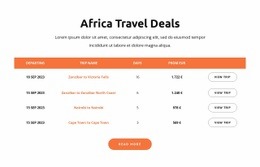
The table already separates each travel deal into a recognizable row: departure, trip name, days, From EUR, and a view-trip link. That organization provides a useful base if the surrounding project later needs custom behavior for a particular travel workflow. For example, a project-specific destination, availability check, itinerary panel, or comparison action could be associated with the existing view-trip area without replacing the heading, explanatory text, or four-row structure.
The centered read-more button creates a second, broader action after the table. Its position distinguishes a general continuation from the row-level view-trip links, so custom functionality should preserve that difference rather than treating every control as the same destination. The static interaction model also means that any dynamic behavior would be an optional extension, not an existing feature of the section. In an HTML Code context, the heading, table, repeated rows, and controls are best treated as bounded content regions around which a project can add custom markup or an external component. Nicepage’s HTML Element can support such additions when the travel project needs functionality beyond the current static comparison, while the block continues to provide the original deal information and visual arrangement.
Customize with Nicepage
Open this ready-made template in the HTML Code Generator and customize it visually in the Nicepage editor. Replace demo content, edit page sections, and adapt the design to your project without rebuilding the template from scratch.
Edit Template Offline
2. Create a new page or select existing
3. Click Add new block, search for id 5631261 and click enter
Edit Template Online
Create Awesome Websites


Free Nicepage Builder
Keywords
Extend This Page With Custom HTML Code
Insert Code With the HTML Element
Use the HTML Element to add custom code directly to a Block in the Nicepage editor. Enter the required markup in the Code field when the page needs content or functionality that is not available through the standard page elements.
Place the HTML Element in the Layout
Treat the HTML Element as part of the visual page composition. Adjust its position, width, height, alignment, and margins to place the custom content where it belongs alongside text, images, buttons, and other elements. This makes it possible to combine visually edited sections with project-specific code without separating the custom element from the rest of the layout.
Add HTML, CSS, JavaScript, and External Components
The HTML Element supports HTML, CSS, and JavaScript, allowing you to extend the page with custom markup and interactive functionality. It can also be used to embed custom code and third-party components, such as social feeds, advertising code, widgets, or other external functionality required by the project.
This workflow makes the template useful for projects that need a visual page editor together with custom HTML code, JavaScript, embedded components, and functionality beyond the standard page elements.

Design Set (19)




More from Travel & Hotels Blocks
-

-

-
-
-
-
-
-
-
-
-
Customize Any TemplateDownload
-
-
-
-
-
-
-
-
-
-





More from Table Blocks
-
-
-
-
-
-
-
-
-
-
-
Customize Any TemplateDownload
-
-
-
-
-
-
-
-
-
-