Innovative Architecture Html Code Example


Four-column location rows create clear extension points
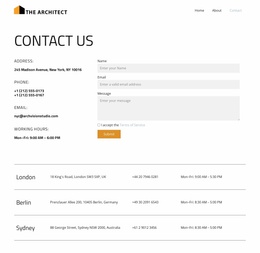
The three repeated rows provide a defined content model for location data: each begins with a city label and continues through address, telephone, and opening-hours columns. That regular sequence is useful when a project needs to add an external map link, booking control, office-status indicator, or another location-specific data element near the relevant row. The existing table remains the organizing reference, so an extension can be associated with London, Berlin, or Sydney without obscuring which details belong together.
Thin horizontal rules reinforce the row boundaries, while the white background and evenly spaced columns leave the content region visually open. This separation gives custom markup or an embedded component a predictable place to relate to the table, whether it is positioned within a row or beside the contact section in the surrounding composition. The city names carry stronger typographic emphasis than the supporting entries, so an added interactive element should preserve that hierarchy rather than compete with the location labels.
For a static contact section, HTML Code intent is therefore about extending the real office-directory structure with project-specific behavior. Custom functionality could connect a city to a map, reveal additional availability, or provide a location-aware action, while the three-row table continues to communicate the core contact information clearly.
Customize with Nicepage
Open this ready-made template in the HTML Code Generator and customize it visually in the Nicepage editor. Replace demo content, edit page sections, and adapt the design to your project without rebuilding the template from scratch.
Edit Template Offline
2. Create a new page or select existing
3. Click Add new block, search for id 6488279 and click enter
Edit Template Online
Create Awesome Websites


Free Nicepage Builder
Keywords
Extend This Page With Custom HTML Code
Insert Code With the HTML Element
Use the HTML Element to add custom code directly to a Block in the Nicepage editor. Enter the required markup in the Code field when the page needs content or functionality that is not available through the standard page elements.
Place the HTML Element in the Layout
Treat the HTML Element as part of the visual page composition. Adjust its position, width, height, alignment, and margins to place the custom content where it belongs alongside text, images, buttons, and other elements. This makes it possible to combine visually edited sections with project-specific code without separating the custom element from the rest of the layout.
Add HTML, CSS, JavaScript, and External Components
The HTML Element supports HTML, CSS, and JavaScript, allowing you to extend the page with custom markup and interactive functionality. It can also be used to embed custom code and third-party components, such as social feeds, advertising code, widgets, or other external functionality required by the project.
This workflow makes the template useful for projects that need a visual page editor together with custom HTML code, JavaScript, embedded components, and functionality beyond the standard page elements.