Winning rules of fashion Website Template
Edit Template Offline
2. Create new page and search for id 36786
Edit Template Online
Create Awesome Websites


Free Nicepage Builder
Keywords
Dress Codes, Startup Guidance, and Seasonal Content Build a Fashion Foundation
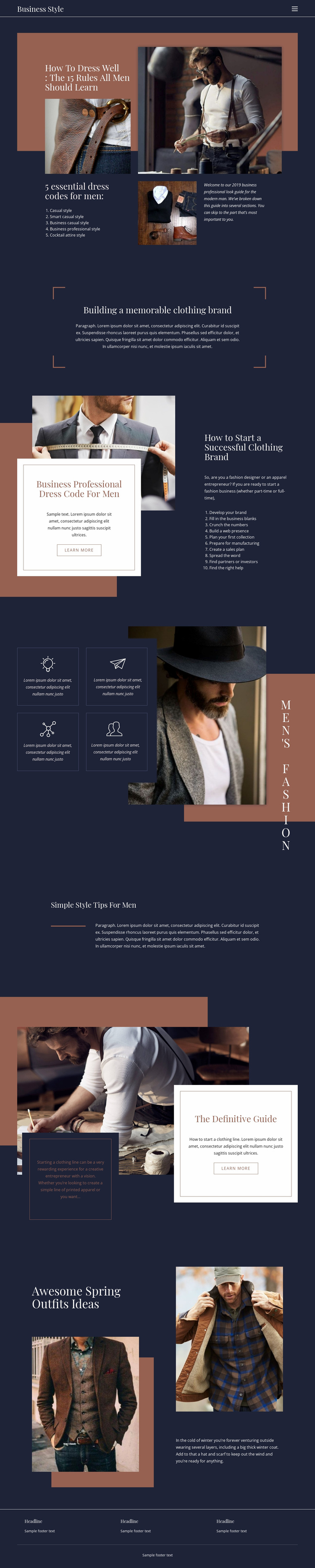
The design provides several major content areas that can form the foundation of a broader men's fashion website. The opening guide establishes the main editorial subject with five dress-code categories, while the Business Style header and horizontal navigation create a clear shared starting point for related pages. Casual, Smart Casual, Business Casual, Business Professional, and Cocktail Attire could each support deeper style guidance without changing the visual direction of the design.
The clothing-brand material gives the project a second expansion path. Its centered positioning statement introduces brand development, and the following ten-step sequence covers business planning, numbers, web presence, collection preparation, manufacturing, sales, promotion, and partnerships. Those subjects can support additional business-oriented content areas for fashion designers or apparel entrepreneurs. The four repeated feature panels offer a compact pattern for adding further style topics, while the seasonal outfit section demonstrates how timely editorial material can fit the same system.
Photography, serif-style headings, geometric accents, and the dark navy, rust, cream, and muted blue palette provide continuity between these possible areas. The existing page should not be treated as proof of a complete multi-page site, but it does define useful categories, navigation context, recurring panels, article relationships, and footer information columns. As a website foundation, it gives a larger project an initial information architecture: personal dressing advice, brand-building guidance, feature content, seasonal inspiration, and shared site regions can grow from one coherent editorial starting point.
Customize with Nicepage
Open this ready-made template in the Website Template Builder and customize it visually in the Nicepage editor. Replace demo content, edit page sections, and adapt the design to your project without rebuilding the template from scratch.
Build a Complete Website From This Template
Customize the Website Visually
Use this ready-made website template as a starting point for your project and adapt its pages visually in Nicepage. Change content, images, typography, navigation, sections, and other design elements while keeping the website together as a single editable project.
Manage Website Pages in One Project
Use the Pages panel to open, add, duplicate, and manage the pages of your website. Work on individual pages while keeping navigation and the overall site structure accessible from the same project, making it easier to develop a complete website instead of managing separate page files.
Expand the Website With Matching Designs
When you need additional pages or sections, use Page Design Sets to find Page and Block Designs created in the same visual style. Design Sets group matching designs together, making it easier to expand the website with new content while maintaining a consistent look across its pages and sections.
Organize Larger Multi-Page Websites
As the website grows, use Page Folders to organize related pages and keep larger multi-page projects easier to navigate in the editor. This is especially useful for websites with separate service pages, company information, contacts, landing pages, and other content areas.
This workflow makes the template a practical foundation for building and expanding a complete website while managing its pages, content, and visual design within one Nicepage project.