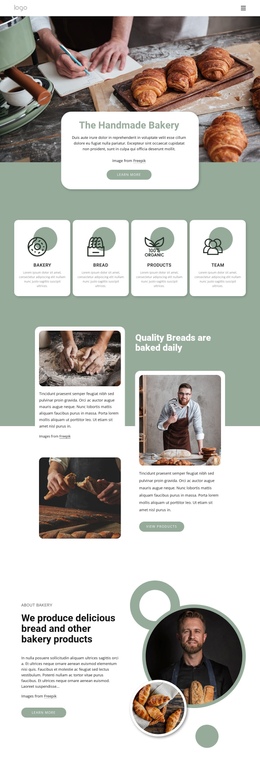
We bake fresh bread and cakes One Page Template


A Distinct Bakery Information Stop Within Continuous Page Flow
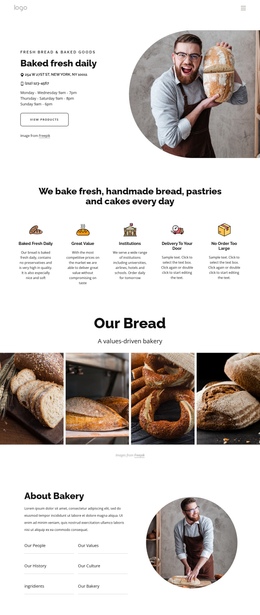
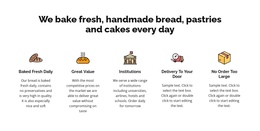
The section has enough internal identity to act as one recognizable destination in a continuous one-page experience. Its heading states the bakery’s central message, and the five repeated items provide a focused set of supporting topics: freshness, value, institutional supply, delivery, and order capacity. Because each topic has its own icon, title, and paragraph, visitors can identify the section’s purpose quickly without depending on a separate page title or a complex interaction.
The five-column row also gives neighboring sections a natural relationship. An introductory block could establish the bakery, this section could explain its practical benefits, and later areas could present products, ordering information, or contact details. That is a content-flow role rather than a claim that navigation anchors already exist. The section’s interaction is static, so all five feature groups remain visible together and can be read in sequence or scanned independently.
The content includes useful structural distinctions. The first description refers to bread baked fresh daily and no preservatives. The Institutions item names universities, airlines, hotels, and schools, while Delivery To Your Door and No Order Too Large indicate service contexts whose sample descriptions still need final editing. The centered heading and evenly distributed columns keep those topics within one coherent bakery destination. In a one-page layout, the block can therefore separate product-and-service benefits from the surrounding introduction and response sections while remaining one section of the larger page.
Customize with Nicepage
Open this ready-made template in the One Page Template Builder and customize it visually in the Nicepage editor. Replace demo content, edit page sections, and adapt the design to your project without rebuilding the template from scratch.
Edit Template Offline
2. Create a new page or select existing
3. Click Add new block, search for id 4873232 and click enter
Edit Template Online
Create Awesome Websites


Free Nicepage Builder
Keywords
Build a Navigable One-Page Website
Connect the Menu to Page Sections
Organize the website as a sequence of sections on a single page and use the Menu For One-Page Site to connect menu items with individual page Blocks. Visitors can jump directly to sections such as About, Services, Testimonials, or Contact without opening separate pages.
Keep the Website on One URL
A one-page template can combine several parts of a small website within one continuous page. Arrange the Header, introduction, services, portfolio, company information, reviews, contact details, and other relevant sections in the order that fits the project while keeping them accessible through the same page navigation.
Make Long Pages Easier to Navigate
For longer one-page websites, keep navigation labels short and connected to meaningful sections so visitors can move through the page without relying only on scrolling. You can also use the Back To Top element to provide a quick way back to the beginning after longer sections.
This workflow makes the template suitable for compact websites that need several distinct content sections while keeping the complete visitor experience on one URL.