Wildlife and nature One Page Template


Edit Template Offline
2. Create new page and search for id 21253
Edit Template Online
Create Awesome Websites


Free Nicepage Builder
Keywords
The Hero-to-Gallery Sequence Creates Several Content Destinations
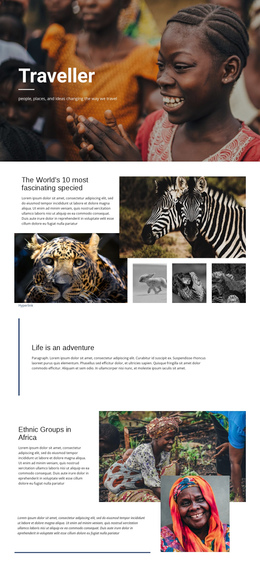
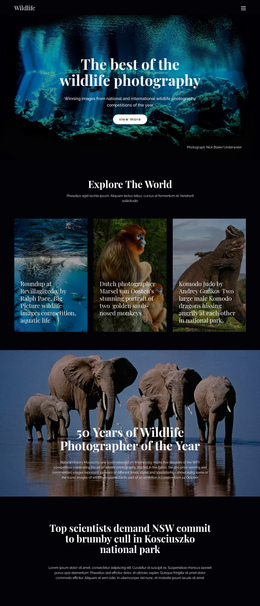
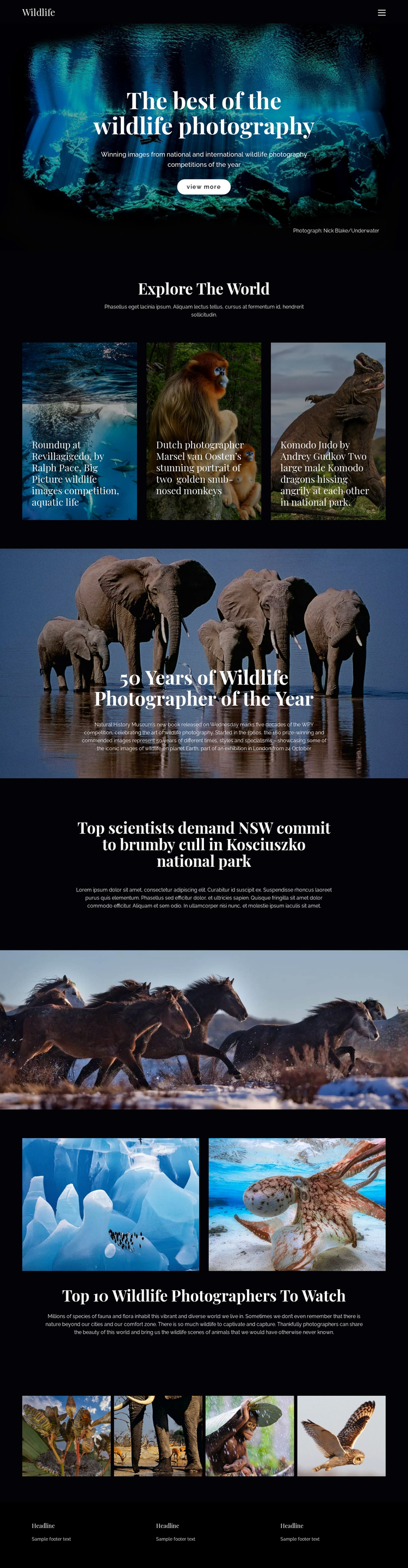
The page works as a continuous document because its sections are substantial enough to act as separate points of interest. The header introduces the Wildlife label and navigation, then the hero provides the opening destination for the featured photography. The “Explore The World” section changes the rhythm into three image panels, with aquatic life, monkeys, and Komodo dragons offering distinct subjects within one visual stop.
Further down, the Wildlife Photographer of the Year section functions as a historical destination rather than another simple gallery. Its elephant photograph and centered editorial copy create room for the competition’s history, book reference, and London exhibition reference. The following conservation panel gives the page a text-focused destination about brumbies in Kosciuszko national park, and the wide horse photograph separates that story from the “Top 10 Wildlife Photographers To Watch” feature.
The final four-image strip provides a concise closing collection before the three-column footer. Together, these stages support movement through introduction, discovery, historical context, conservation, photographer coverage, and visual conclusion. The page can therefore be interpreted as a one-page content journey with multiple meaningful sections, without claiming that anchor links or a particular one-page menu already exist.
Customize with Nicepage
Open this ready-made template in the One Page Template Builder and customize it visually in the Nicepage editor. Replace demo content, edit page sections, and adapt the design to your project without rebuilding the template from scratch.
Build a Navigable One-Page Website
Connect the Menu to Page Sections
Organize the website as a sequence of sections on a single page and use the Menu For One-Page Site to connect menu items with individual page Blocks. Visitors can jump directly to sections such as About, Services, Testimonials, or Contact without opening separate pages.
Keep the Website on One URL
A one-page template can combine several parts of a small website within one continuous page. Arrange the Header, introduction, services, portfolio, company information, reviews, contact details, and other relevant sections in the order that fits the project while keeping them accessible through the same page navigation.
Make Long Pages Easier to Navigate
For longer one-page websites, keep navigation labels short and connected to meaningful sections so visitors can move through the page without relying only on scrolling. You can also use the Back To Top element to provide a quick way back to the beginning after longer sections.
This workflow makes the template suitable for compact websites that need several distinct content sections while keeping the complete visitor experience on one URL.