Travel Assistant One Page Template


Edit Template Offline
2. Create new page and search for id 12890
Edit Template Online
Create Awesome Websites


Free Nicepage Builder
Keywords
Eight sections create a continuous travel information journey
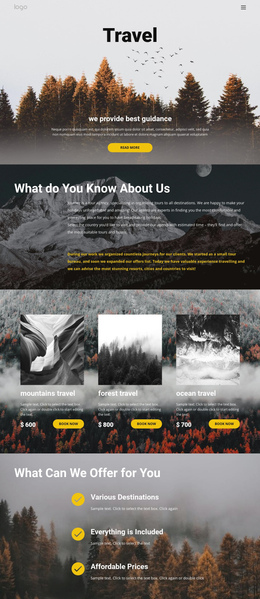
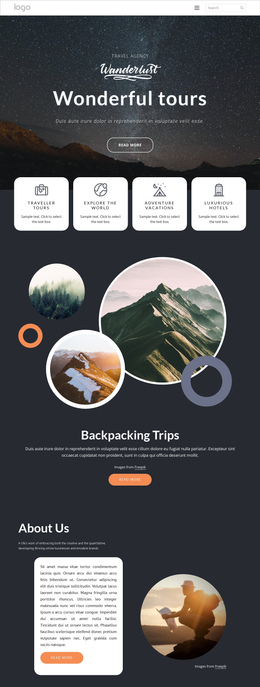
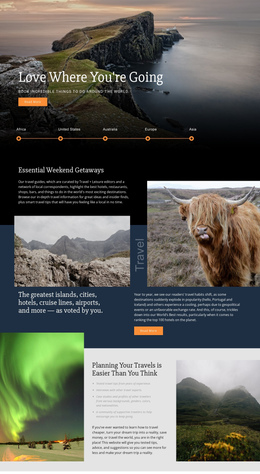
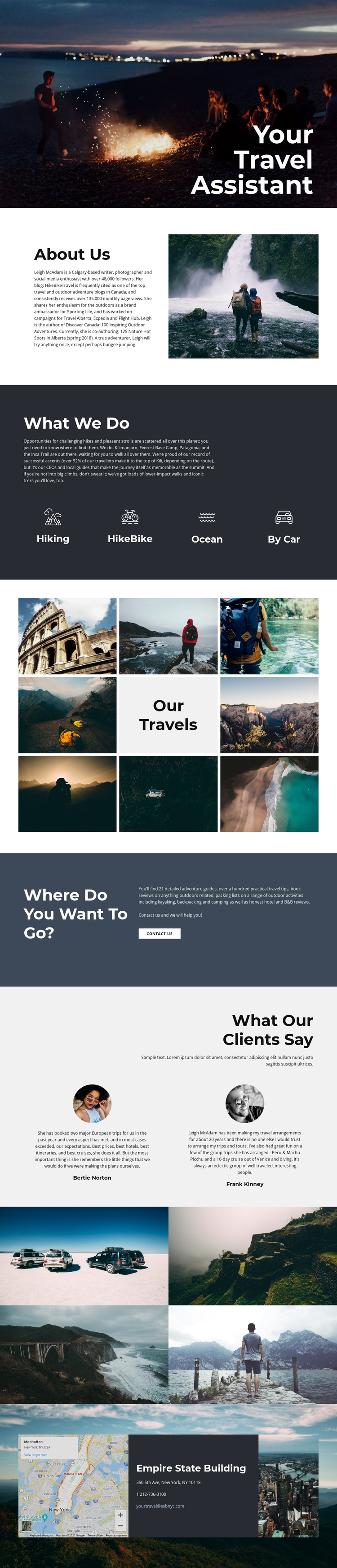
The page’s sections can be read as a sequence of distinct destinations within one continuous document. The opening hero introduces the travel assistant, and the About Us area follows with biography content beside a hiking image. The What We Do section then provides a separate information stop through the Hiking, HikeBike, Ocean, and By Car categories, allowing visitors to understand the range of travel themes before reaching the visual content.
The first gallery changes the experience from explanation to exploration. Its eight photographs surround the Our travels tile, creating a recognizable destination within the page rather than blending into the preceding text. The Where do you want to go? panel follows with a Contact us button, but the page continues through two testimonial profiles and a second four-image mosaic. This means the design supports several content destinations—about, categories, travel imagery, inquiry, client perspective, and additional imagery—without requiring each one to become a separate URL.
The final Contacts section completes the sequence with a map, location information, telephone number, email address, and a city photograph. Those practical details give the visitor a natural endpoint after the longer visual journey. The design therefore works as a one-page structure because its major blocks have different informational roles while remaining connected by one scrolling experience.
Customize with Nicepage
Open this ready-made template in the One Page Template Builder and customize it visually in the Nicepage editor. Replace demo content, edit page sections, and adapt the design to your project without rebuilding the template from scratch.
Build a Navigable One-Page Website
Connect the Menu to Page Sections
Organize the website as a sequence of sections on a single page and use the Menu For One-Page Site to connect menu items with individual page Blocks. Visitors can jump directly to sections such as About, Services, Testimonials, or Contact without opening separate pages.
Keep the Website on One URL
A one-page template can combine several parts of a small website within one continuous page. Arrange the Header, introduction, services, portfolio, company information, reviews, contact details, and other relevant sections in the order that fits the project while keeping them accessible through the same page navigation.
Make Long Pages Easier to Navigate
For longer one-page websites, keep navigation labels short and connected to meaningful sections so visitors can move through the page without relying only on scrolling. You can also use the Back To Top element to provide a quick way back to the beginning after longer sections.
This workflow makes the template suitable for compact websites that need several distinct content sections while keeping the complete visitor experience on one URL.