Schedule HTML Template


A Complete Static Section for Class Registration
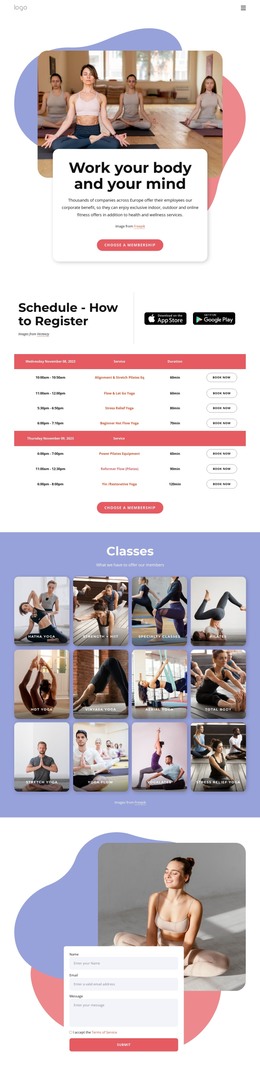
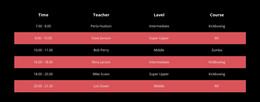
The heading, app-store badges, timetable, booking controls, and membership action form a finished registration section that can sit inside a static HTML page. The upper introduction explains the section’s purpose through “Schedule - How to Register,” while the badges provide a separate visual route for app-related access. Beneath it, the full-width table keeps two date groups and seven class entries together so visitors can compare times, services, and durations before selecting an action.
The table’s content is specific enough to carry the core schedule message without needing the surrounding page to reinterpret every row. Yoga, Pilates, reformer, and restorative services appear as distinct class choices, and each entry has its own Book Now control. The Choose a membership button then creates a secondary action below the immediate registration list rather than blending it into the rows.
Used as an HTML Template section, this block can be placed inside a larger static page while other sections provide navigation, introductory context, or additional contact information. Its visual arrangement is already defined through coral schedule headers, muted service labels, spacious white alignment, and rounded controls. The containing HTML project supplies the page-level structure; this block supplies the ready-made timetable and registration content area.
Customize with Nicepage
Open this ready-made template in the HTML Builder and customize it visually in the Nicepage editor. Replace demo content, edit page sections, and adapt the design to your project without rebuilding the template from scratch.
Edit Template Offline
2. Create a new page or select existing
3. Click Add new block, search for id 6037536 and click enter
Edit Template Online
Create Awesome Websites


Free Nicepage Builder
Keywords
Use This Block in a Static HTML Page
Start With a Ready-Made Section
A block provides one prepared content area that can be combined with other sections to build a static HTML page. Customize its text, images, spacing, colors, and other elements in the Nicepage editor while keeping the block focused on its own purpose, such as services, testimonials, pricing, contact information, or visual presentation.
Export the Containing HTML Project
When the page or website that contains the block is ready, use HTML Export to create the files required for a static HTML project. The export applies to the containing page/site rather than turning one individual block into a complete website by itself.
Reuse the Section Within the Project
The same block design can be adapted as one content section within a larger static site. Other Blocks can provide navigation, introductions, portfolios, forms, footers, and additional page content while this section keeps its own verified content and layout role.
This workflow makes the block useful as a ready-made section inside a static HTML implementation, with export and deployment handled at the page or website level.