Award winning tours HTML Template


Three destination panels ready for a static HTML section
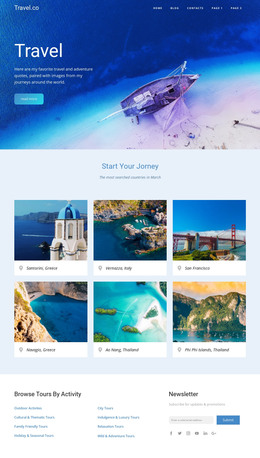
The three image panels create one finished visual gallery region rather than a collection of unrelated pictures. Each panel has equal width, and the single horizontal row gives the destination imagery a clear shared frame. Narrow white gutters separate the photographs without interrupting the sequence, so the eye can compare the coastal architecture, tropical beach, and colorful urban buildings as parts of one travel-oriented presentation.
Inside a static HTML page or site, this block can provide a ready-made destination showcase between text-led sections, itinerary details, or other travel content. Because the block contains images only and has no heading, captions, or confirmed controls, the surrounding page can supply the explanatory copy and links while this section remains focused on visual discovery. Its self-contained arrangement makes it practical when a page needs three places or scenes to be visible at once rather than hidden behind a slider.
The gallery can also act as a stable visual reference for the content around it. Related descriptions may follow the same left-to-right order as the photographs, helping visitors connect each image with its surrounding information. The section remains one reusable static HTML component; navigation, additional content, and page-level structure belong to the containing project.
Customize with Nicepage
Open this ready-made template in the HTML Builder and customize it visually in the Nicepage editor. Replace demo content, edit page sections, and adapt the design to your project without rebuilding the template from scratch.
Edit Template Offline
2. Create a new page or select existing
3. Click Add new block, search for id 56686 and click enter
Edit Template Online
Create Awesome Websites


Free Nicepage Builder
Keywords
Export and Use This Template as an HTML Website
Create a Portable HTML Website
When the template is ready, use the HTML Export option to create a static website with the files required for deployment. The exported website can be used independently of the Nicepage editor and deployed on your preferred hosting.
Nicepage also provides SEO settings and optimization features, including Page Titles and Descriptions, Canonical settings, headings, image Alt Text, and other page-level properties that help prepare the website for search engines.
Deploy Without a CMS
Upload the finished website to the hosting environment that fits your project. Because the exported site does not require WordPress, Joomla, or another CMS to deliver its pages, it can be placed on your own server, uploaded to a hosting provider, or deployed through an existing web infrastructure.
Hand Off the Website Files
The generated website files can also be provided to a client, developer, or hosting team. They remain available outside the Nicepage editor for deployment, technical review, or project-specific development when additional work is required.
This workflow makes the template a practical foundation for a portable static website that can be exported from the Nicepage editor and deployed independently.


More from Travel & Hotels Blocks
-
-

-
-
-
-
-
-
-
-
-
Free Website Builder SoftwareDownload
-
-
-
-
-
-
-
-
-
-







More from Grid Blocks
-
-
-
-
-
-
-
-
-
-
-
Free Website Builder SoftwareDownload
-
-
-
-
-
-
-
-
-
-