Shopping in Milan HTML Template
Edit Template Offline
2. Create new page and search for id 545711
Edit Template Online
Create Awesome Websites


Free Nicepage Builder
Keywords
A Milan Guide Arranged as a Complete Static Travel Page
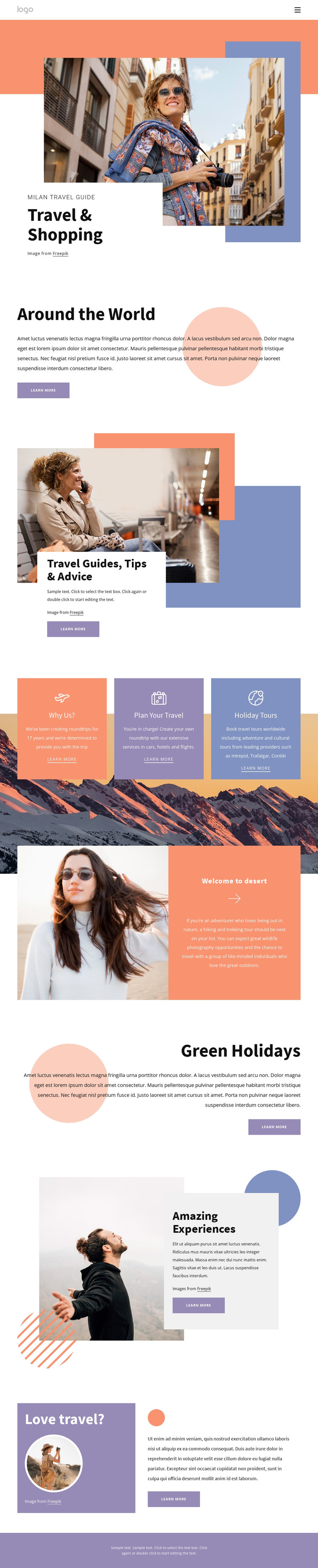
The page already brings together the main content relationships expected in a self-contained travel presentation. The opening photograph and Milan Travel Guide heading establish a destination-led entry point, while Around the World broadens the subject before the page moves into Travel Guides, Tips & Advice. This progression allows the design to introduce travel inspiration and then provide a more practical reason to continue exploring.
The three colored cards add a compact category layer for Why Us?, Plan Your Travel, and Holiday Tours. They work as a visual bridge between the introductory material and the later feature sections, which include hiking and trekking, Green Holidays, and Amazing Experiences. Because the page also presents planning involving cars, hotels, and flights and refers to worldwide holiday tours, it covers several related travel themes without requiring the visitor to leave the main presentation immediately.
The closing Love travel? block returns to a broad invitation after the more specific travel topics, and the repeated Learn more buttons give the static layout consistent points for linking to additional information. As an HTML Template, its value lies in this finished arrangement of images, headings, cards, text panels, actions, and footer content. It is more than an isolated hero concept: the major informational sections needed for a standalone travel guide page are already assembled.
Customize with Nicepage
Open this ready-made template in the HTML Builder and customize it visually in the Nicepage editor. Replace demo content, edit page sections, and adapt the design to your project without rebuilding the template from scratch.
Export and Use This Template as an HTML Website
Create a Portable HTML Website
When the template is ready, use the HTML Export option to create a static website with the files required for deployment. The exported website can be used independently of the Nicepage editor and deployed on your preferred hosting.
Nicepage also provides SEO settings and optimization features, including Page Titles and Descriptions, Canonical settings, headings, image Alt Text, and other page-level properties that help prepare the website for search engines.
Deploy Without a CMS
Upload the finished website to the hosting environment that fits your project. Because the exported site does not require WordPress, Joomla, or another CMS to deliver its pages, it can be placed on your own server, uploaded to a hosting provider, or deployed through an existing web infrastructure.
Hand Off the Website Files
The generated website files can also be provided to a client, developer, or hosting team. They remain available outside the Nicepage editor for deployment, technical review, or project-specific development when additional work is required.
This workflow makes the template a practical foundation for a portable static website that can be exported from the Nicepage editor and deployed independently.

More from Travel & Hotels HTML Templates
-
Free Website Builder SoftwareDownload