Car repair contacts Html Code Example


Edit Template Offline
2. Create new page and search for id 6455519
Edit Template Online
Create Awesome Websites


Free Nicepage Builder
Keywords
Contact Zones That Leave Room for Useful Extensions
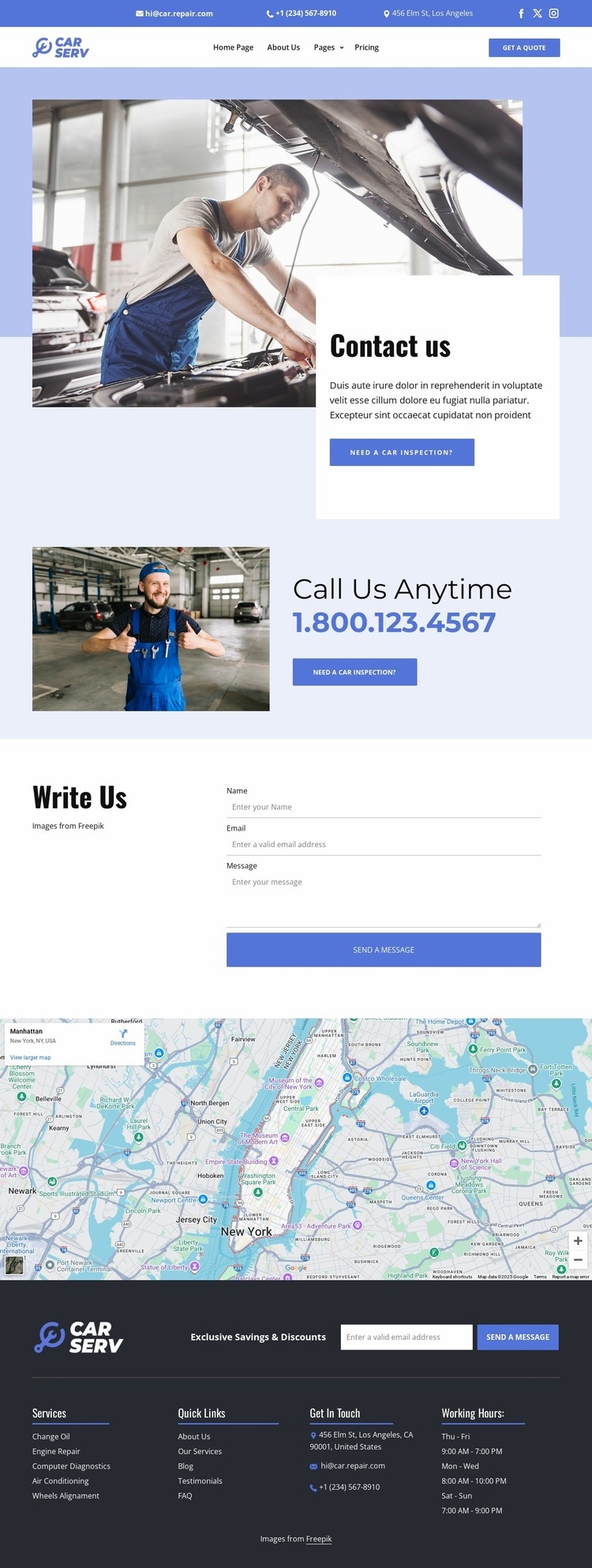
The contact bar, hero, phone section, inquiry form, map, and footer already divide the page into clear integration zones. The upper contact area can remain focused on immediate details and navigation, while the hero and “Call Us Anytime” block provide natural places for project-specific interactive content associated with inspections or quote requests. The existing separation between phone contact and written inquiry is especially useful because an added component can support one channel without obscuring the other.
The “Write Us” section supplies a defined form area beside explanatory text, and the full-width map establishes a separate location context below it. If a project needs functionality beyond the standard contact elements, custom markup could be placed near the relevant section rather than forcing a redesign of the whole page. For example, an external scheduling, estimate, or service-status component could sit beside the appropriate contact path while preserving the page’s blue, white, and dark navy visual structure. The footer also contains service links, contact details, working hours, and an email signup form, giving additional content zones for carefully scoped extensions. The value of the HTML Code version lies in these relationships: existing contact purposes remain legible while additional functionality can be added where visitors already expect it.
Customize with Nicepage
Open this ready-made template in the HTML Code Generator and customize it visually in the Nicepage editor. Replace demo content, edit page sections, and adapt the design to your project without rebuilding the template from scratch.
Extend This Page With Custom HTML Code
Insert Code With the HTML Element
Use the HTML Element to add custom code directly to a Block in the Nicepage editor. Enter the required markup in the Code field when the page needs content or functionality that is not available through the standard page elements.
Place the HTML Element in the Layout
Treat the HTML Element as part of the visual page composition. Adjust its position, width, height, alignment, and margins to place the custom content where it belongs alongside text, images, buttons, and other elements. This makes it possible to combine visually edited sections with project-specific code without separating the custom element from the rest of the layout.
Add HTML, CSS, JavaScript, and External Components
The HTML Element supports HTML, CSS, and JavaScript, allowing you to extend the page with custom markup and interactive functionality. It can also be used to embed custom code and third-party components, such as social feeds, advertising code, widgets, or other external functionality required by the project.
This workflow makes the template useful for projects that need a visual page editor together with custom HTML code, JavaScript, embedded components, and functionality beyond the standard page elements.

Design Set (17)














More from Cars & Transportation Html Code Examples
-
Customize Any TemplateDownload