Motosport Html Code Example


Edit Template Offline
2. Create new page and search for id 16938
Edit Template Online
Create Awesome Websites


Free Nicepage Builder
Keywords
Article Features Provide Natural Extension Points
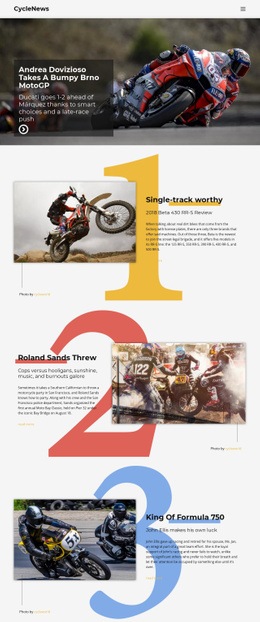
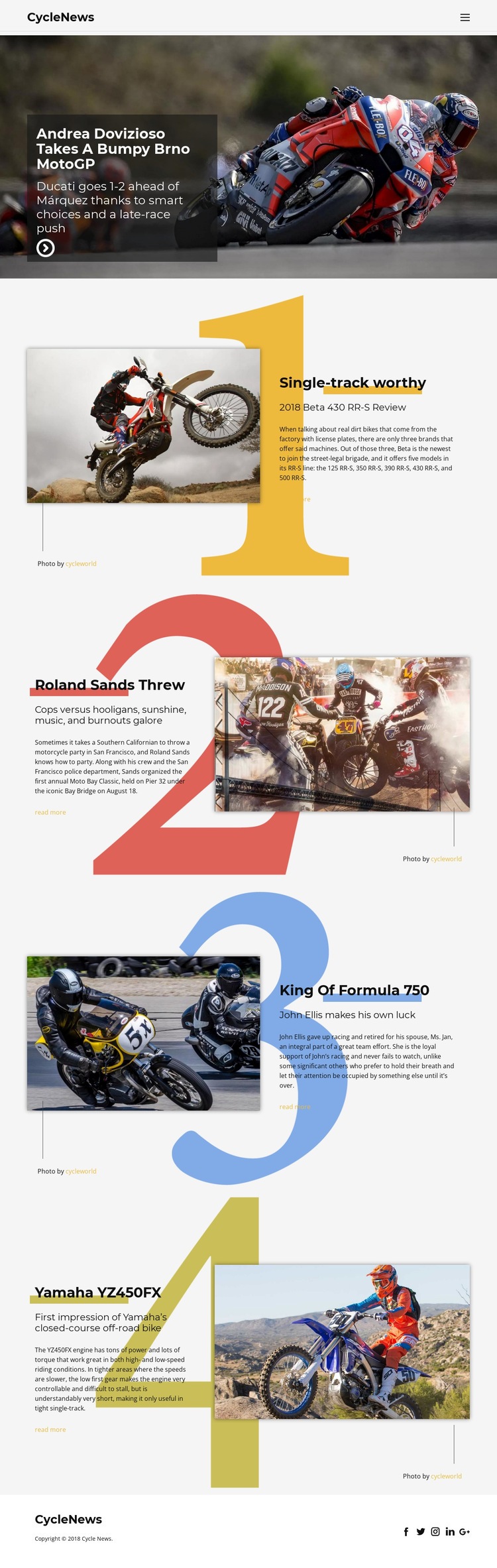
The page already divides its editorial material into clear content zones. The opening MotoGP feature places the main headline and summary over a large racing photograph, creating a strong area for the publication's primary story. Below it, the four numbered features separate different kinds of motorcycle coverage: an off-road review of the Beta 430 RR-S, the Moto Bay Classic event story, a Formula 750 racing feature, and a Yamaha YZ450FX review. Each zone pairs an image with a title, supporting text, and a Read more action, so additional functionality can be related to a specific story rather than inserted into an undifferentiated page.
Those existing zones could accommodate project-specific extensions when the standard article presentation is not enough. A custom component might sit alongside an individual story to support an external article feed, a richer media presentation, or another editorial service, provided the added functionality matches the surrounding content. The header also gives a defined location for navigation-related extensions, while the social footer already identifies destinations for publication connections. The HTML Element is available when custom markup is required, but the template analysis does not show that custom code is already present. Its value here is the combination of a finished editorial arrangement and clearly bounded places where additional functionality could be introduced without rebuilding the page.
Customize with Nicepage
Open this ready-made template in the HTML Code Generator and customize it visually in the Nicepage editor. Replace demo content, edit page sections, and adapt the design to your project without rebuilding the template from scratch.
Extend This Page With Custom HTML Code
Insert Code With the HTML Element
Use the HTML Element to add custom code directly to a Block in the Nicepage editor. Enter the required markup in the Code field when the page needs content or functionality that is not available through the standard page elements.
Place the HTML Element in the Layout
Treat the HTML Element as part of the visual page composition. Adjust its position, width, height, alignment, and margins to place the custom content where it belongs alongside text, images, buttons, and other elements. This makes it possible to combine visually edited sections with project-specific code without separating the custom element from the rest of the layout.
Add HTML, CSS, JavaScript, and External Components
The HTML Element supports HTML, CSS, and JavaScript, allowing you to extend the page with custom markup and interactive functionality. It can also be used to embed custom code and third-party components, such as social feeds, advertising code, widgets, or other external functionality required by the project.
This workflow makes the template useful for projects that need a visual page editor together with custom HTML code, JavaScript, embedded components, and functionality beyond the standard page elements.

More from Cars & Transportation Html Code Examples
-
Customize Any TemplateDownload