Bronco Rc Car Html Code Example


Edit Template Offline
2. Create new page and search for id 14117
Edit Template Online
Create Awesome Websites


Free Nicepage Builder
Keywords
Remote Differentials and Feature Cards Create Clear Extension Points
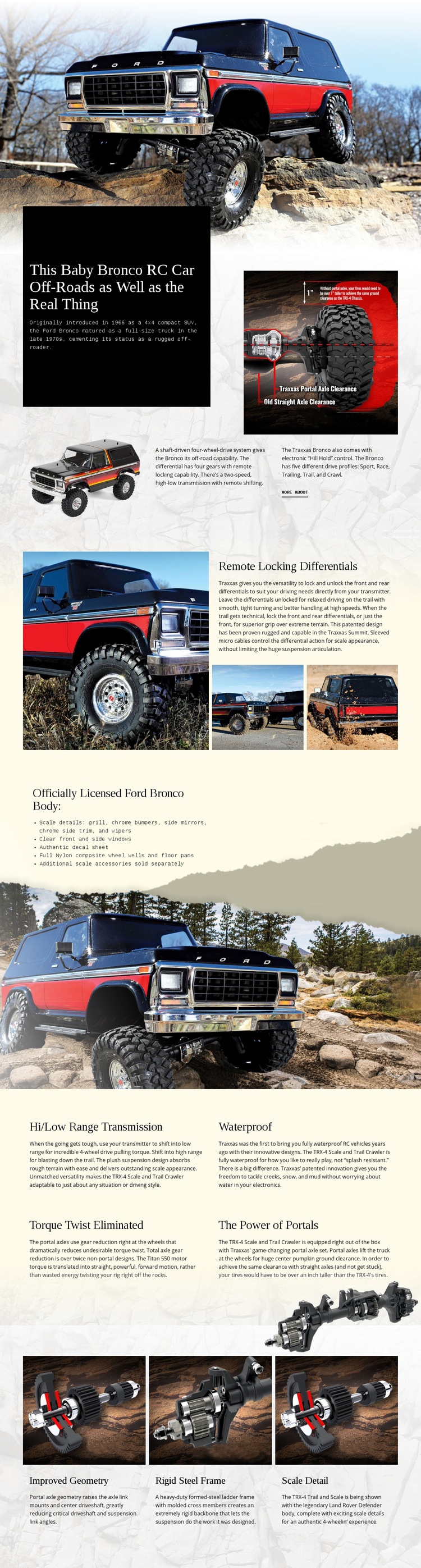
The page already separates the product story into distinct content zones that can accommodate project-specific additions without changing the main presentation. The opening image and introductory section establish the vehicle context, while the remote locking differentials block combines one large photograph, explanatory text, and two smaller detail images. That arrangement creates a natural boundary beside a feature that may later need an external specification panel, comparison component, or related media element.
The licensed body section offers another focused area. Its list of chrome bumpers, side mirrors, side trim, wipers, clear windows, and an authentic decal sheet is presented over a vehicle background, so an added content element would need to respect the existing text-over-image relationship. The four technical blocks below provide more regular insertion points because each item already follows a repeated feature pattern covering transmission, waterproof construction, torque twist, and portal power.
Custom HTML should therefore extend a real content relationship rather than replace the established design. For example, a project could place an external product-detail component near the technical features or connect the More About link to additional information while preserving the page’s image-led sequence. Nicepage documents the HTML Element for adding external code when standard page elements do not cover a required function. The existing layout remains the visual framework; custom functionality can be added selectively around it.
Customize with Nicepage
Open this ready-made template in the HTML Code Generator and customize it visually in the Nicepage editor. Replace demo content, edit page sections, and adapt the design to your project without rebuilding the template from scratch.
Extend This Page With Custom HTML Code
Insert Code With the HTML Element
Use the HTML Element to add custom code directly to a Block in the Nicepage editor. Enter the required markup in the Code field when the page needs content or functionality that is not available through the standard page elements.
Place the HTML Element in the Layout
Treat the HTML Element as part of the visual page composition. Adjust its position, width, height, alignment, and margins to place the custom content where it belongs alongside text, images, buttons, and other elements. This makes it possible to combine visually edited sections with project-specific code without separating the custom element from the rest of the layout.
Add HTML, CSS, JavaScript, and External Components
The HTML Element supports HTML, CSS, and JavaScript, allowing you to extend the page with custom markup and interactive functionality. It can also be used to embed custom code and third-party components, such as social feeds, advertising code, widgets, or other external functionality required by the project.
This workflow makes the template useful for projects that need a visual page editor together with custom HTML code, JavaScript, embedded components, and functionality beyond the standard page elements.

More from Cars & Transportation Html Code Examples
-
Customize Any TemplateDownload