Travel Blog Website Template
Edit Template Offline
2. Create new page and search for id 21070
Edit Template Online
Create Awesome Websites


Free Nicepage Builder
Keywords
Destination Categories Establish a Foundation for Broader Travel Content
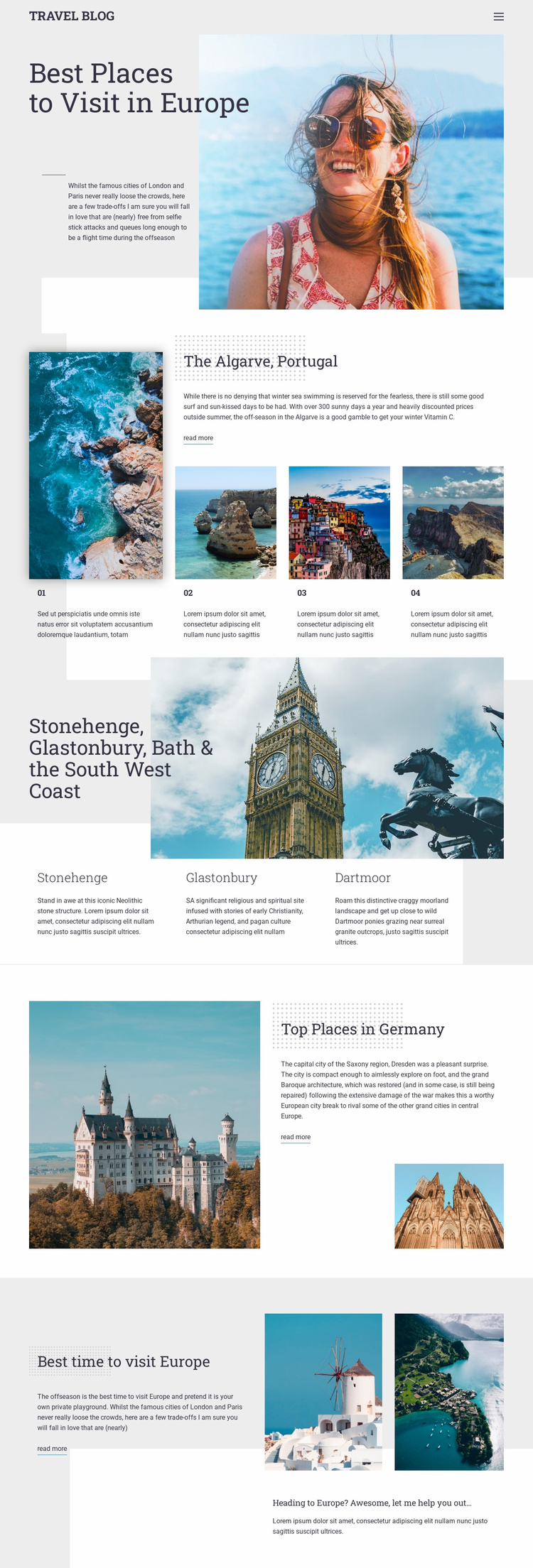
The page already identifies several major content areas that could guide a larger travel website. The header and eight-link navigation provide a shared frame, while the hero introduces the broad European destination subject. The Algarve story gives Portugal a featured regional entry with supporting numbered items, showing how one destination can contain both a lead article and related recommendations.
South West England supplies a contrasting regional structure. Stonehenge, Glastonbury, Dartmoor, and the South West Coast appear under one scenic image with three aligned descriptions, so the design can distinguish a region from the individual places within it. Germany then uses a different editorial arrangement: a large landscape photograph, Dresden-related text, and supporting imagery create a country-focused content area. These relationships suggest an information architecture that could expand through matching destination or regional pages, but the analysis confirms only the current page.
Seasonal guidance adds a planning category alongside geographic coverage. “Best time to visit Europe,” two travel images, and the closing prompt give the project a practical content direction beyond inspiration alone. The read-more links reinforce a path toward detailed articles. As a website-project foundation, the value lies in these identifiable categories, reusable image-and-text patterns, and navigation structure. It should not be described as an existing multi-page site or complete design set without separate evidence.
Customize with Nicepage
Open this ready-made template in the Website Template Builder and customize it visually in the Nicepage editor. Replace demo content, edit page sections, and adapt the design to your project without rebuilding the template from scratch.
Build a Complete Website From This Template
Customize the Website Visually
Use this ready-made website template as a starting point for your project and adapt its pages visually in Nicepage. Change content, images, typography, navigation, sections, and other design elements while keeping the website together as a single editable project.
Manage Website Pages in One Project
Use the Pages panel to open, add, duplicate, and manage the pages of your website. Work on individual pages while keeping navigation and the overall site structure accessible from the same project, making it easier to develop a complete website instead of managing separate page files.
Expand the Website With Matching Designs
When you need additional pages or sections, use Page Design Sets to find Page and Block Designs created in the same visual style. Design Sets group matching designs together, making it easier to expand the website with new content while maintaining a consistent look across its pages and sections.
Organize Larger Multi-Page Websites
As the website grows, use Page Folders to organize related pages and keep larger multi-page projects easier to navigate in the editor. This is especially useful for websites with separate service pages, company information, contacts, landing pages, and other content areas.
This workflow makes the template a practical foundation for building and expanding a complete website while managing its pages, content, and visual design within one Nicepage project.