Personal campus education Website Template


Edit Template Offline
2. Create new page and search for id 16521
Edit Template Online
Create Awesome Websites


Free Nicepage Builder
Keywords
Courses, Staff, and Editorial Areas Establish a Site Foundation
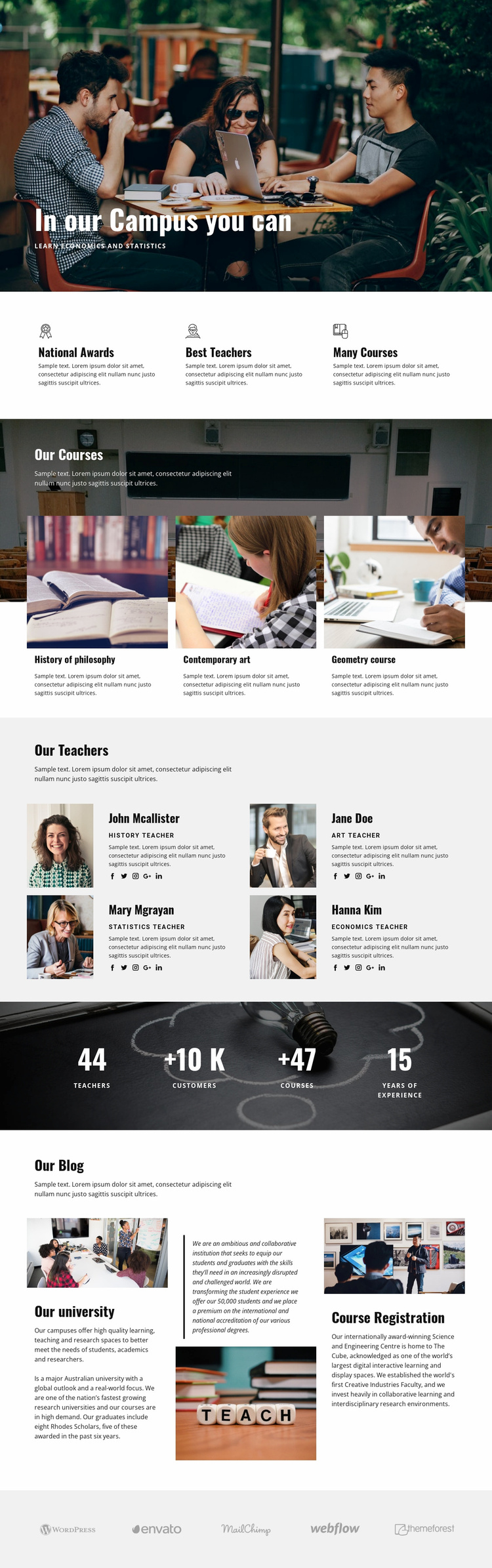
The design already identifies several major content categories that an education website may need. The hero introduces the campus, and the three feature items summarize institutional strengths before the page moves into the three course cards. Those cards can represent the core academic offering area, while the four teacher profiles create a separate staff or faculty category with portraits, roles, descriptions, and social links.
The four labeled metrics provide an institutional summary band, and the three blog-style columns create a place for university information, Course Registration material, and other editorial subjects. These areas are structurally different enough to guide future page expansion: course detail pages could follow the course group, staff information could grow from the profile section, and recurring news or guidance could relate to the blog area. The five logo marks can remain a shared association or partner region near the end of the site.
The analysis verifies one page, not a complete multi-page website. Its value as a Website Template therefore comes from the information architecture already visible in this design and from the content categories that could support additional pages later. The repeated three- and four-item patterns, dark image bands, and lighter content sections provide a consistent foundation while the project grows beyond the initial campus presentation.
Customize with Nicepage
Open this ready-made template in the Website Template Builder and customize it visually in the Nicepage editor. Replace demo content, edit page sections, and adapt the design to your project without rebuilding the template from scratch.
Build a Complete Website From This Template
Customize the Website Visually
Use this ready-made website template as a starting point for your project and adapt its pages visually in Nicepage. Change content, images, typography, navigation, sections, and other design elements while keeping the website together as a single editable project.
Manage Website Pages in One Project
Use the Pages panel to open, add, duplicate, and manage the pages of your website. Work on individual pages while keeping navigation and the overall site structure accessible from the same project, making it easier to develop a complete website instead of managing separate page files.
Expand the Website With Matching Designs
When you need additional pages or sections, use Page Design Sets to find Page and Block Designs created in the same visual style. Design Sets group matching designs together, making it easier to expand the website with new content while maintaining a consistent look across its pages and sections.
Organize Larger Multi-Page Websites
As the website grows, use Page Folders to organize related pages and keep larger multi-page projects easier to navigate in the editor. This is especially useful for websites with separate service pages, company information, contacts, landing pages, and other content areas.
This workflow makes the template a practical foundation for building and expanding a complete website while managing its pages, content, and visual design within one Nicepage project.