English no rules school Website Template
Edit Template Offline
2. Create new page and search for id 119405
Edit Template Online
Create Awesome Websites


Free Nicepage Builder
Keywords
Course, instructor, and learner content establish a site foundation
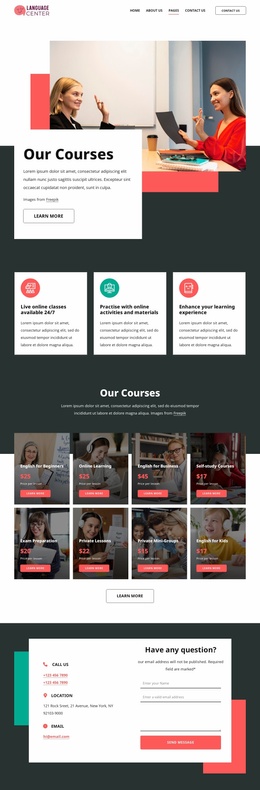
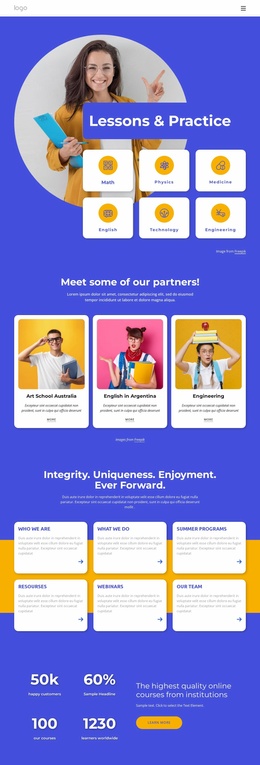
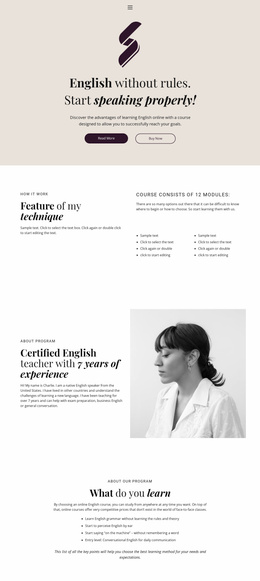
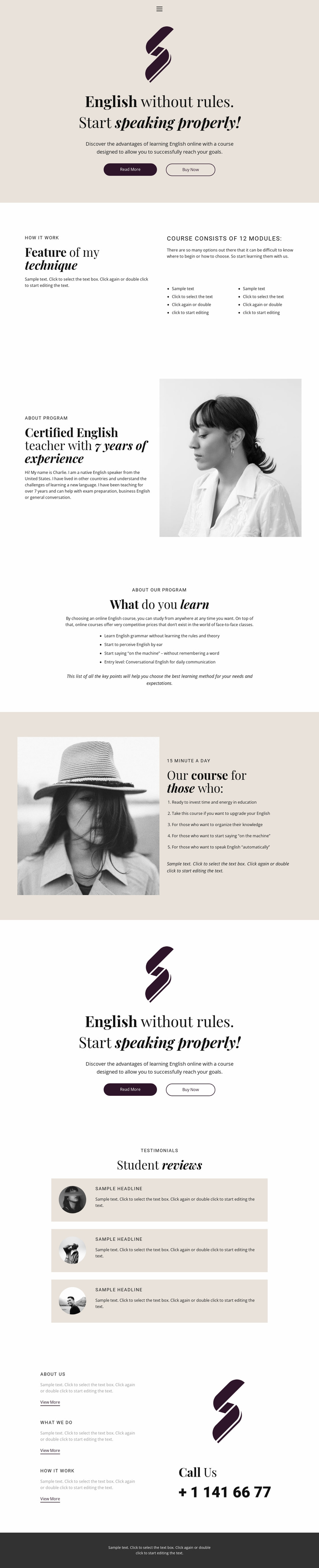
The existing design already identifies several major content areas that an education website may need. The hero introduces the English course and its primary actions, while the technique section explains the teaching approach and gives the offer a 12-module reference. The instructor profile adds a personal content category, and the four learning outcomes provide a separate area for communicating what learners may study. These regions create more than a decorative homepage: they establish an initial information structure for the course project.
The audience section adds a learner-focused category through five statements and a daily-study reference. The repeated promotion keeps the offer visible, while the three student review cards provide a distinct proof area that could remain part of the site’s broader content direction. Near the end, About Us, What We Do, and How It Work cards create additional informational destinations before the phone contact. Shared navigation, a mobile control, and a footer frame the page consistently. If the project later expands, these confirmed content areas could guide related pages for the course, instructor, learning method, or contact information. The analysis verifies one page, not an existing multi-page set, so the expansion language describes a foundation rather than claiming that additional pages are already included.
Customize with Nicepage
Open this ready-made template in the Website Template Builder and customize it visually in the Nicepage editor. Replace demo content, edit page sections, and adapt the design to your project without rebuilding the template from scratch.
Build a Complete Website From This Template
Customize the Website Visually
Use this ready-made website template as a starting point for your project and adapt its pages visually in Nicepage. Change content, images, typography, navigation, sections, and other design elements while keeping the website together as a single editable project.
Manage Website Pages in One Project
Use the Pages panel to open, add, duplicate, and manage the pages of your website. Work on individual pages while keeping navigation and the overall site structure accessible from the same project, making it easier to develop a complete website instead of managing separate page files.
Expand the Website With Matching Designs
When you need additional pages or sections, use Page Design Sets to find Page and Block Designs created in the same visual style. Design Sets group matching designs together, making it easier to expand the website with new content while maintaining a consistent look across its pages and sections.
Organize Larger Multi-Page Websites
As the website grows, use Page Folders to organize related pages and keep larger multi-page projects easier to navigate in the editor. This is especially useful for websites with separate service pages, company information, contacts, landing pages, and other content areas.
This workflow makes the template a practical foundation for building and expanding a complete website while managing its pages, content, and visual design within one Nicepage project.