Hosting plans CSS Template


Edit Template Offline
2. Create new page and search for id 6513633
Edit Template Online
Create Awesome Websites


Free Nicepage Builder
Keywords
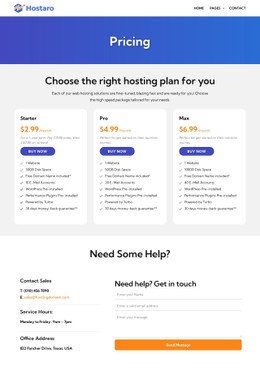
Blue gradients and white cards define the hosting-plan style
The page uses a compact visual system that makes the hosting offer easy to scan. A full-width blue gradient band isolates the opening Pricing heading from the comparison area, creating a strong first visual marker without adding competing content. Below it, three white pricing cards share the same horizontal treatment, so plan names, monthly pricing, feature lists, and Buy now actions can be compared as parallel units rather than unrelated panels.
Rounded card shapes, generous white space, and compact sans-serif typography keep the commercial information approachable and controlled. The centered introduction above the cards provides a quiet transition from the saturated banner to the denser plan comparison. The later assistance section repeats white panels beside a contact form, extending the same contrast pattern from self-service purchase toward sales support. This relationship is important to the page styling: the offer cards carry the main visual weight, while the help area uses matching surfaces to remain connected to the comparison section.
The saturated blue footer closes the page with a darker visual anchor. Contact channels, help links, service links, and the hosting description are grouped into a structured lower region rather than scattered across the page. Together, the gradients, white surfaces, rounded corners, spacing, and repeated panel treatment form a consistent appearance that can be refined without losing the page’s pricing hierarchy.
Customize with Nicepage
Open this ready-made template in the CSS Template Builder and customize it visually in the Nicepage editor. Replace demo content, edit page sections, and adapt the design to your project without rebuilding the template from scratch.
Customize This Template With CSS
Control Page-Specific Styling
Customize the visual appearance of this ready-made template directly in the Nicepage editor. Adjust typography, spacing, backgrounds, borders, colors, positioning, and other style properties using visual controls while keeping the page layout easy to manage without writing CSS manually.
Add Custom CSS When Needed
For styling requirements that go beyond the standard editor options, use Custom CSS to add targeted rules. CSS can be applied to individual elements, specific pages, or the entire website depending on the scope of the customization, while CSS classes can be used to connect custom rules with selected elements.
Export Minimal CSS Per Page
For projects where CSS size and page performance matter, Nicepage can export minimal CSS for each page. Instead of relying on one larger common stylesheet, each page can use a separate CSS file containing only the style rules required for that particular page. According to Nicepage documentation, these page-specific CSS files can be about ten times more compact, helping reduce unnecessary CSS and improve page loading performance.
This workflow combines visual styling with optional custom CSS and optimized page-specific CSS output, giving you additional control when a project requires it without making manual CSS editing the primary way to customize the template.