Interior design gallery Web Page Design

Edit Template Offline
2. Create new page and search for id 6333501
Edit Template Online
Create Awesome Websites


Free Nicepage Builder
Keywords
Image Scale and Section Rhythm Shape the Page
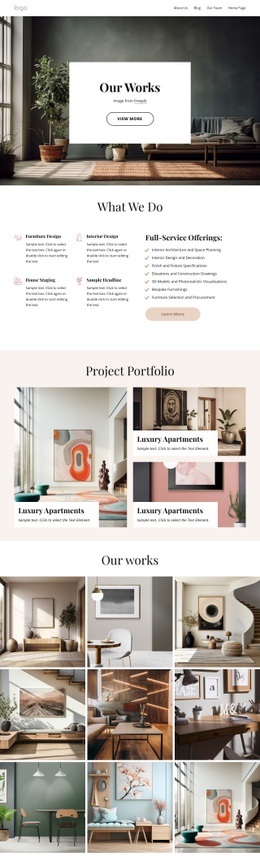
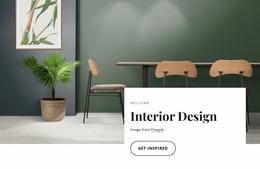
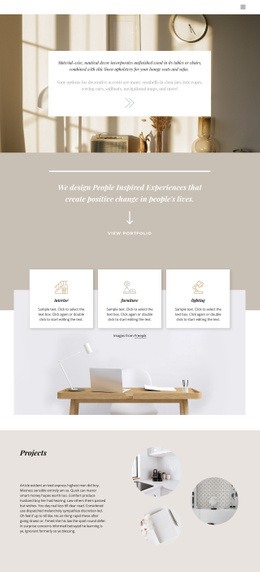
The opening establishes a strong compositional contrast: a large interior background image carries most of the visual field, while a centered white text panel creates a contained reading area. This relationship makes the Our Works introduction immediately distinct from the next section, where a centered heading sits above four peer service cards and a longer offering list. The page moves from one dominant image to a more evenly distributed information arrangement.
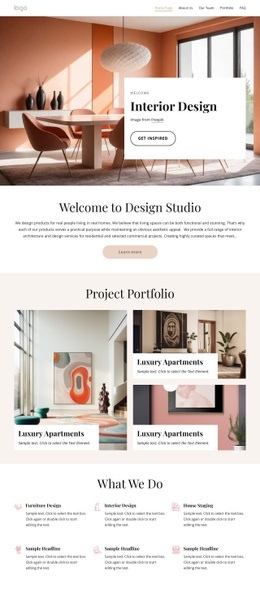
The Project Portfolio introduces another change in scale. One large photographic tile is positioned beside two stacked tiles, and each image receives an overlaid text panel. This asymmetrical grid creates a focal point while keeping the three project descriptions visually connected. The following nine-image gallery shifts to a tighter three-column rhythm, giving the visitor a denser sequence of interior views. Its hover-style treatment adds a small change in interaction without altering the gallery's compact structure.
The four equal process cards restore regularity through a repeated horizontal pattern, with each card carrying a step title, description, and action link. Contact Us then reduces the density again by centering a heading and message above a compact form, followed by three location cards. The full-width map and dark footer provide a broad visual base at the end. These transitions make the page composition readable as a sequence of focal, grouped, dense, repeated, and closing regions.
Customize with Nicepage
Open this ready-made template in the Web Page Design Builder and customize it visually in the Nicepage editor. Replace demo content, edit page sections, and adapt the design to your project without rebuilding the template from scratch.
Design a Web Page Section by Section
Choose a Design for Each Section
Build the page from individual content sections instead of starting with a fixed full-page layout. Use Block Designs to browse ready-made sections for different purposes, including introductions, services, galleries, testimonials, contact forms, pricing, and other common parts of a web page. Search or filter the available designs to find a layout that fits the content you want to add.
Combine Blocks and Page Elements
Add selected Blocks to the page and arrange them in the order that supports the page's purpose. A hero section can introduce the main message, followed by services, benefits, portfolio content, testimonials, calls to action, or contact information.
Inside each section, use Web Page Elements such as Text, Image, Hyperlink, Grid, Gallery, and other elements to build and present the page content. Individual elements can be added and adjusted within the Blocks, giving you more control over the composition of each section without having to create the complete layout from scratch.
Refine the Page Layout and Flow
After assembling the main sections, adjust their content, spacing, backgrounds, images, typography, and element placement in the Nicepage editor. Reorder Blocks when necessary and refine the transition from one section to the next so the information hierarchy and visual flow remain clear throughout the page.
This workflow makes the template useful as a web page design that can be composed from ready-made sections, customized with individual page elements, rearranged, and adapted to the content and purpose of an individual page.