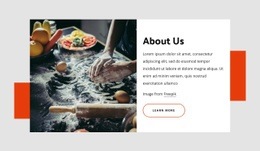
Mexican salad Web Page Design


The Text Column Sets the Rhythm Beside a Dominant Photograph
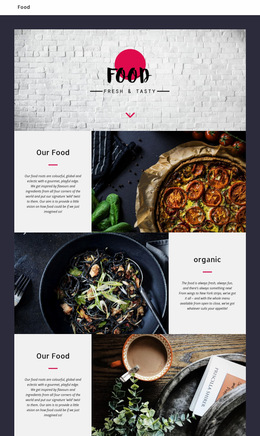
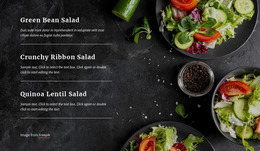
The page composition begins with a compact text area on the left and a large food photograph on the right. The “Salads and snacks” heading gives the section an immediate entry point, while the yellow horizontal divider creates a pause before the four listed labels. Because the labels are centered and grouped tightly, they form a controlled information column rather than spreading across the full width. The photograph then supplies a contrasting area of scale and visual density.
This asymmetrical balance can work as a strong mid-page composition: visitors encounter a readable category statement and item group alongside a single image that is large enough to define the section’s character. The white background separates the two areas without adding a heavy panel, while the yellow brush-like framing around the photograph echoes the divider and helps the composition feel intentional. The arrangement remains static, so its hierarchy is communicated through position, size, and contrast rather than motion.
When placed within one webpage, the block can create a visual transition between sections with different content density. The left side carries the concise food references; the right side prevents the section from becoming a plain list. Neighboring blocks can handle other restaurant information, while this unit contributes one clear category and its supporting image. Its page-design role comes from how those regions share attention, not from claiming to contain the whole page.
Customize with Nicepage
Open this ready-made template in the Web Page Design Builder and customize it visually in the Nicepage editor. Replace demo content, edit page sections, and adapt the design to your project without rebuilding the template from scratch.
Edit Template Offline
2. Create a new page or select existing
3. Click Add new block, search for id 533283 and click enter
Edit Template Online
Create Awesome Websites


Free Nicepage Builder
Keywords
Design a Web Page Section by Section
Choose a Design for Each Section
Build the page from individual content sections instead of starting with a fixed full-page layout. Use Block Designs to browse ready-made sections for different purposes, including introductions, services, galleries, testimonials, contact forms, pricing, and other common parts of a web page. Search or filter the available designs to find a layout that fits the content you want to add.
Combine Blocks and Page Elements
Add selected Blocks to the page and arrange them in the order that supports the page's purpose. A hero section can introduce the main message, followed by services, benefits, portfolio content, testimonials, calls to action, or contact information.
Inside each section, use Web Page Elements such as Text, Image, Hyperlink, Grid, Gallery, and other elements to build and present the page content. Individual elements can be added and adjusted within the Blocks, giving you more control over the composition of each section without having to create the complete layout from scratch.
Refine the Page Layout and Flow
After assembling the main sections, adjust their content, spacing, backgrounds, images, typography, and element placement in the Nicepage editor. Reorder Blocks when necessary and refine the transition from one section to the next so the information hierarchy and visual flow remain clear throughout the page.
This workflow makes the template useful as a web page design that can be composed from ready-made sections, customized with individual page elements, rearranged, and adapted to the content and purpose of an individual page.