Ranking university education One Page Template


Edit Template Offline
2. Create new page and search for id 16526
Edit Template Online
Create Awesome Websites


Free Nicepage Builder
Keywords
Ten Content Zones Create a Continuous Education Journey
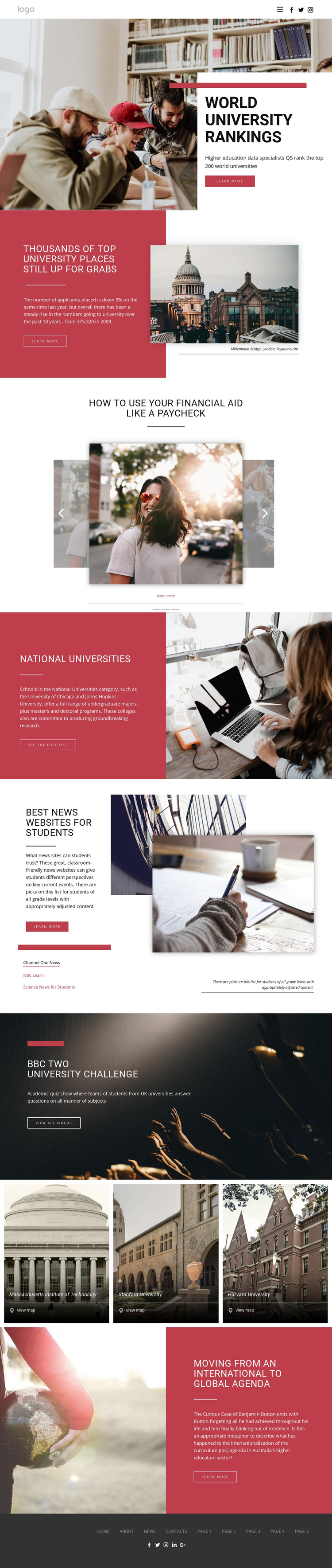
The long page is suited to a one-page information structure because its major sections behave as distinct destinations within one document. The header establishes the starting point, and the World University Rankings feature provides the first subject area. From there, the admissions feature changes the topic from general ranking information to university places, while the three-slide story section groups related financial aid, continuing education, and mentor content in one navigable zone.
The National Universities panel and student news resource section offer additional destinations with different information purposes. The later BBC Two University Challenge feature changes the experience from reading to video, and the repeated cards for Massachusetts Institute of Technology, Stanford University, and Harvard University create a compact university directory with map actions. The international education commentary section provides a final editorial subject before the footer returns visitors to navigation and social access.
This sequence supports continuous exploration without requiring every topic to become a separate page. Each large content group can be treated as a meaningful stopping point for a visitor moving through rankings, admissions, resources, media, listings, and international commentary. The interpretation depends on the verified section order and varied content roles, not on assuming that anchor navigation already exists. The page’s one-document logic comes from the way these areas are arranged together.
Customize with Nicepage
Open this ready-made template in the One Page Template Builder and customize it visually in the Nicepage editor. Replace demo content, edit page sections, and adapt the design to your project without rebuilding the template from scratch.
Build a Navigable One-Page Website
Connect the Menu to Page Sections
Organize the website as a sequence of sections on a single page and use the Menu For One-Page Site to connect menu items with individual page Blocks. Visitors can jump directly to sections such as About, Services, Testimonials, or Contact without opening separate pages.
Keep the Website on One URL
A one-page template can combine several parts of a small website within one continuous page. Arrange the Header, introduction, services, portfolio, company information, reviews, contact details, and other relevant sections in the order that fits the project while keeping them accessible through the same page navigation.
Make Long Pages Easier to Navigate
For longer one-page websites, keep navigation labels short and connected to meaningful sections so visitors can move through the page without relying only on scrolling. You can also use the Back To Top element to provide a quick way back to the beginning after longer sections.
This workflow makes the template suitable for compact websites that need several distinct content sections while keeping the complete visitor experience on one URL.