Eating essentials for food Landing Page
Edit Template Offline
2. Create new page and search for id 38011
Edit Template Online
Create Awesome Websites


Free Nicepage Builder
Keywords
From Organic Garden to a Direct Sustainability Inquiry
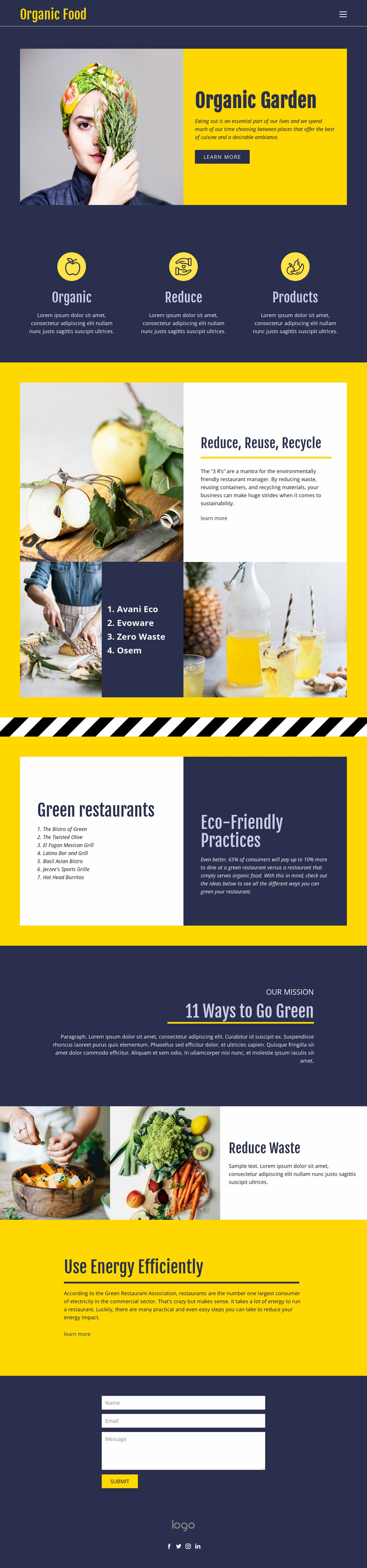
The opening split gives the page a clear first impression: produce imagery introduces Organic Garden while the adjacent yellow panel supplies the initial explanation and Learn more action. The three feature items that follow—Organic, Reduce, and Products—then clarify the main themes before visitors reach the more detailed sustainability material. This progression lets the page establish context before asking for a response.
The middle sections work as supporting evidence and practical guidance. Reduce, Reuse, Recycle gives the subject a concrete environmental frame through food imagery, a numbered list, and explanatory copy. Green restaurants and Eco-Friendly Practices shift the focus toward restaurant application, while Reduce Waste and Use Energy Efficiently address two specific operational concerns. The central 11 Ways to Go Green message ties those topics to one recognizable initiative instead of presenting unrelated tips.
The compact contact form near the bottom is the strongest response point because it follows the explanatory sequence and provides a direct place for an inquiry. The social footer remains secondary, allowing the page to retain a single response direction. The design therefore supports a campaign-style interpretation without requiring invented prices, offers, statistics, or claims about completed environmental results. Its conversion logic comes from subject introduction, practical guidance, mission framing, and final contact access.
Customize with Nicepage
Open this ready-made template in the Landing Page Builder and customize it visually in the Nicepage editor. Replace demo content, edit page sections, and adapt the design to your project without rebuilding the template from scratch.
Build a Landing Page Around One Conversion Goal
Focus on One Primary Action
Use the landing page to guide visitors toward one measurable response, such as requesting a quote, registering, subscribing, booking a consultation, applying for a service, or submitting an inquiry. Keep the primary call-to-action consistent across the important sections so the headline, supporting content, form, and CTA buttons work toward the same campaign goal instead of competing for attention.
Capture Leads With a Form
Use the Contact Form Element to add a contact, subscription, application, or other conversion form directly to the landing page. Customize the form fields, layout, labels, inputs, and button to collect the information required for your campaign while keeping the form focused on the action you want visitors to complete.
Nicepage also provides several form submission options. Form submissions can be sent to Email, stored as Leads, added to Google Sheets, passed to a custom URL or server endpoint, or used to populate a MailChimp mailing list. This provides practical options for collecting inquiries, registrations, subscriptions, applications, and other campaign responses.
Manage Leads and Campaign Responses
When submissions are stored as Leads, you can use Contact Form Leads to review the information collected through the landing page and use it for follow-up. Keep the form connected to the same offer and primary CTA presented throughout the page so visitors move from the campaign message to a clear conversion action.
This workflow makes the template suitable for landing pages where the offer, content, call-to-action, form, and lead collection process work together toward one defined conversion goal.

More from Food & Restaurant Landing Pages
-
Free Website Builder SoftwareDownload