Hard roads of industiral Landing Page
Edit Template Offline
2. Create new page and search for id 17580
Edit Template Online
Create Awesome Websites


Free Nicepage Builder
Keywords
Freight Proof Builds Toward a Shipping Quote
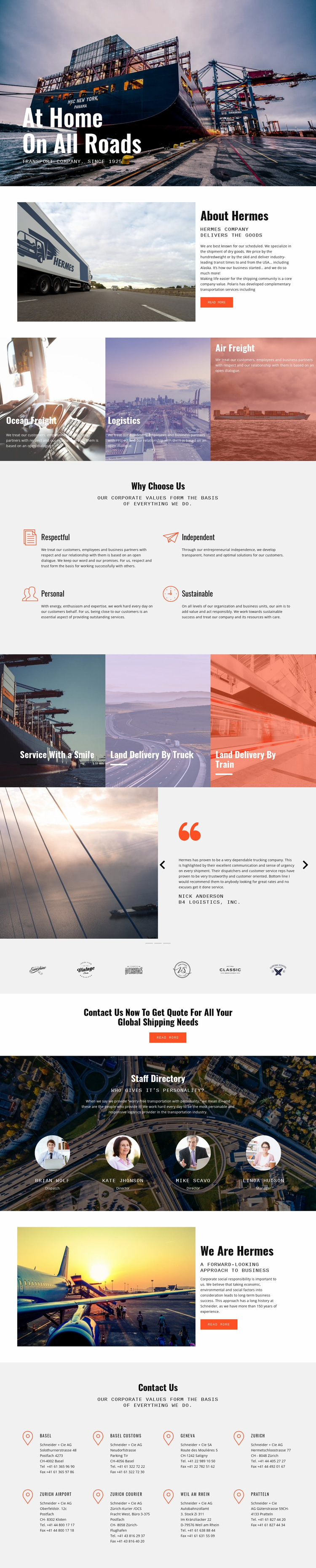
The port hero establishes a broad freight proposition before the About Hermes section explains the company beside a road photograph. That opening gives visitors context first, then the three service tiles clarify the available categories through Ocean Freight, Logistics, and Air Freight. Land delivery by truck and train follows as more specific evidence of transport coverage, allowing the page to move from a general promise to recognizable delivery methods.
The four values—Respectful, Independent, Personal, and Sustainable—support the company message without introducing a separate competing offer. Three testimonial entries and the partner or client logo strip then add reassurance through customer-facing and association-oriented content. Because these sections sit between the service explanation and the quote callout, they can function as supporting proof rather than unrelated company history.
The strongest response point is the accent-colored section headed “Contact Us Now To Get Quote For All Your Global Shipping Needs.” It gives the page a visible destination for visitors who have already seen the service categories, values, and testimonials. Staff profiles and office information remain useful for visitors needing additional confidence or local context, but the sequence keeps the quote request as the clearest next action. The result is a logistics landing-page structure centered on contact and quotation intent.
Customize with Nicepage
Open this ready-made template in the Landing Page Builder and customize it visually in the Nicepage editor. Replace demo content, edit page sections, and adapt the design to your project without rebuilding the template from scratch.
Build a Landing Page Around One Conversion Goal
Focus on One Primary Action
Use the landing page to guide visitors toward one measurable response, such as requesting a quote, registering, subscribing, booking a consultation, applying for a service, or submitting an inquiry. Keep the primary call-to-action consistent across the important sections so the headline, supporting content, form, and CTA buttons work toward the same campaign goal instead of competing for attention.
Capture Leads With a Form
Use the Contact Form Element to add a contact, subscription, application, or other conversion form directly to the landing page. Customize the form fields, layout, labels, inputs, and button to collect the information required for your campaign while keeping the form focused on the action you want visitors to complete.
Nicepage also provides several form submission options. Form submissions can be sent to Email, stored as Leads, added to Google Sheets, passed to a custom URL or server endpoint, or used to populate a MailChimp mailing list. This provides practical options for collecting inquiries, registrations, subscriptions, applications, and other campaign responses.
Manage Leads and Campaign Responses
When submissions are stored as Leads, you can use Contact Form Leads to review the information collected through the landing page and use it for follow-up. Keep the form connected to the same offer and primary CTA presented throughout the page so visitors move from the campaign message to a clear conversion action.
This workflow makes the template suitable for landing pages where the offer, content, call-to-action, form, and lead collection process work together toward one defined conversion goal.

More from Industrial Landing Pages
-
Free Website Builder SoftwareDownload