Solving household problems Landing Page
Edit Template Offline
2. Create new page and search for id 1112428
Edit Template Online
Create Awesome Websites


Free Nicepage Builder
Keywords
Emergency Help, Service Range, and Proof Build Toward an Appointment
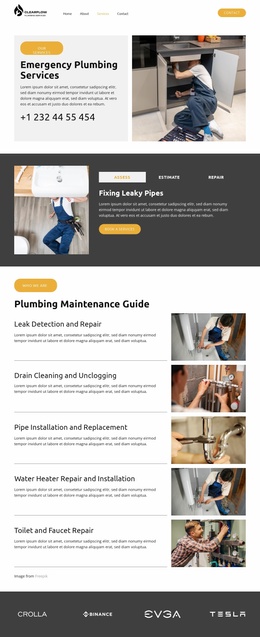
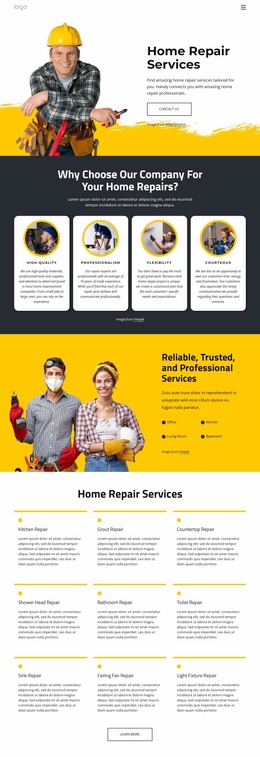
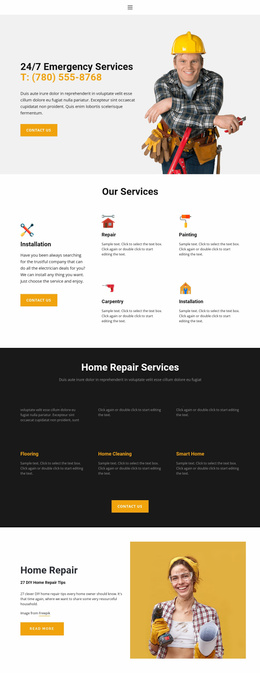
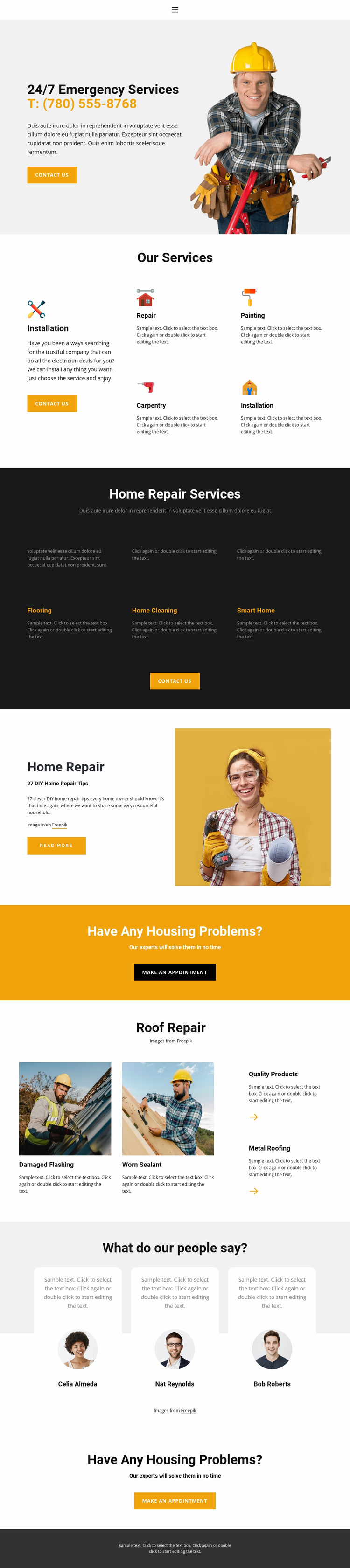
The opening section gives the page a direct response starting point: “24/7 Emergency Services” appears beside a worker photograph, a displayed telephone number, and a contact button. This combination puts urgency, service context, visual evidence, and an immediate contact channel in the same first impression. The following service overview broadens the offer with installation, repair, painting, and carpentry, so visitors can connect the initial emergency message with a wider maintenance scope.
The darker Home Repair Services section continues that progression through six additional categories: painting, plumbing, remodeling, flooring, home cleaning, and smart home. Because these items are grouped together before another contact action, the section can help visitors recognize a relevant need without losing sight of the response path. The featured repair article and the roof repair section then add supporting detail. Roof examples address damaged flashing, worn sealant, quality products, and metal roofing, giving the page a more specific service context than a generic home-services introduction.
Three testimonial cards appear later as a separate proof area, followed by a second “Have Any Housing Problems?” banner and Make an Appointment button. That repetition reinforces the intended next step after visitors have reviewed services and supporting content. The page’s conversion logic therefore depends on progression: urgent contact first, service breadth next, specialized information and testimonials afterward, then a renewed appointment invitation.
Customize with Nicepage
Open this ready-made template in the Landing Page Builder and customize it visually in the Nicepage editor. Replace demo content, edit page sections, and adapt the design to your project without rebuilding the template from scratch.
Build a Landing Page Around One Conversion Goal
Focus on One Primary Action
Use the landing page to guide visitors toward one measurable response, such as requesting a quote, registering, subscribing, booking a consultation, applying for a service, or submitting an inquiry. Keep the primary call-to-action consistent across the important sections so the headline, supporting content, form, and CTA buttons work toward the same campaign goal instead of competing for attention.
Capture Leads With a Form
Use the Contact Form Element to add a contact, subscription, application, or other conversion form directly to the landing page. Customize the form fields, layout, labels, inputs, and button to collect the information required for your campaign while keeping the form focused on the action you want visitors to complete.
Nicepage also provides several form submission options. Form submissions can be sent to Email, stored as Leads, added to Google Sheets, passed to a custom URL or server endpoint, or used to populate a MailChimp mailing list. This provides practical options for collecting inquiries, registrations, subscriptions, applications, and other campaign responses.
Manage Leads and Campaign Responses
When submissions are stored as Leads, you can use Contact Form Leads to review the information collected through the landing page and use it for follow-up. Keep the form connected to the same offer and primary CTA presented throughout the page so visitors move from the campaign message to a clear conversion action.
This workflow makes the template suitable for landing pages where the offer, content, call-to-action, form, and lead collection process work together toward one defined conversion goal.

More from Industrial Landing Pages
-
Free Website Builder SoftwareDownload