Alpine Dreams Ski Tour HTML Template


Three Finished Tiles for a Static Travel Section
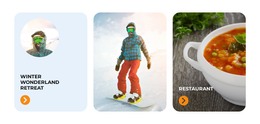
The block already brings together three distinct visual categories in one prepared arrangement: a winter retreat, a snow-sports scene, and a restaurant experience. The three adjacent tiles share rounded corners and generous gaps, so the section can sit inside a static HTML page as a recognizable content area without requiring its core visual organization to be invented. The first tile establishes a softer editorial entry with pale blue, a circular portrait image, and dark stacked text for “Winter Wonderland Retreat.”
The middle tile is image-led and shows a winter sports participant on snow without a visible label. That gives the surrounding page an immediate visual category while keeping the row from becoming text-heavy. The third tile balances a close-up soup or stew image with white “Restaurant” text and an orange circular arrow accent; another tile repeats the orange accent, linking the categories visually. In a static HTML context, this section can carry a compact set of travel and hospitality choices while neighboring sections provide broader introductions, navigation, or additional information. Its value lies in being a finished three-tile arrangement with selective labels, varied imagery, and a clear horizontal rhythm.
Customize with Nicepage
Open this ready-made template in the HTML Builder and customize it visually in the Nicepage editor. Replace demo content, edit page sections, and adapt the design to your project without rebuilding the template from scratch.
Edit Template Offline
2. Create a new page or select existing
3. Click Add new block, search for id 6423393 and click enter
Edit Template Online
Create Awesome Websites


Free Nicepage Builder
Keywords
Export and Use This Template as an HTML Website
Create a Portable HTML Website
When the template is ready, use the HTML Export option to create a static website with the files required for deployment. The exported website can be used independently of the Nicepage editor and deployed on your preferred hosting.
Nicepage also provides SEO settings and optimization features, including Page Titles and Descriptions, Canonical settings, headings, image Alt Text, and other page-level properties that help prepare the website for search engines.
Deploy Without a CMS
Upload the finished website to the hosting environment that fits your project. Because the exported site does not require WordPress, Joomla, or another CMS to deliver its pages, it can be placed on your own server, uploaded to a hosting provider, or deployed through an existing web infrastructure.
Hand Off the Website Files
The generated website files can also be provided to a client, developer, or hosting team. They remain available outside the Nicepage editor for deployment, technical review, or project-specific development when additional work is required.
This workflow makes the template a practical foundation for a portable static website that can be exported from the Nicepage editor and deployed independently.

Design Set (14)
-

-
-
-
-
-
Free Website Builder SoftwareDownload
-
-
-
-

More from Travel & Hotels Blocks
-
-
-
-
-
-
-
-
-
-
-
Free Website Builder SoftwareDownload
-
-
-
-
-
-
-
-
-
-

More from Thirds Blocks
-

-
-
-
-
-
-
-
-
-
-
Free Website Builder SoftwareDownload
-
-
-
-
-
-
-
-
-
-