Mission To Mars HTML Template


Edit Template Offline
2. Create new page and search for id 12792
Edit Template Online
Create Awesome Websites


Free Nicepage Builder
Keywords
A Complete Static Mission Feature From Hero to Footer
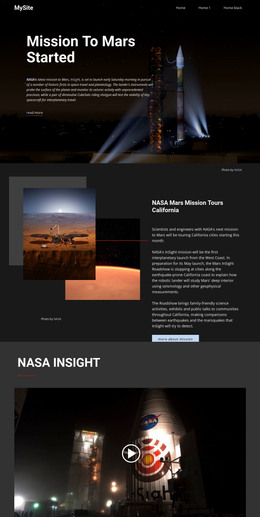
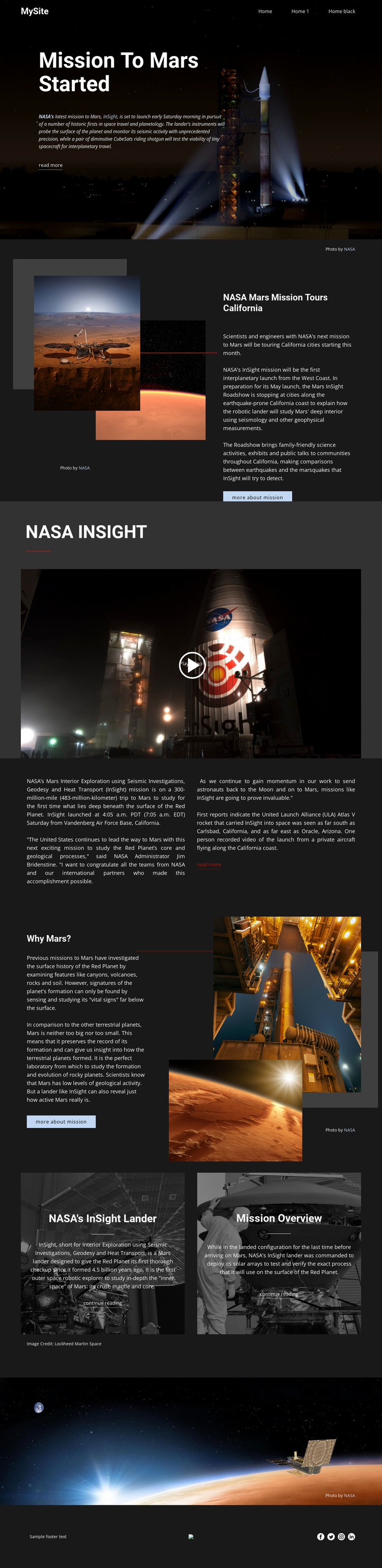
The opening rocket image and “Mission to Mars Started” headline establish the subject immediately, then the page develops that subject through several finished editorial sections rather than leaving the central story to be assembled later. The California roadshow feature adds a public-facing dimension, and the full-width NASA INSIGHT video introduces a distinct media moment between text-led sections. Together, these parts give the static page both narrative progression and visual variation.
The two-column launch and research section supplies denser explanatory content, while “Why Mars?” places scientific reasoning beside Mars and spacecraft imagery. The pair of image-backed panels then separates “NASA’s InSight lander” from “Mission Overview,” giving readers additional paths through the same subject. Repeated reading links, the wide closing spacecraft image, and the social footer complete the page’s content coverage without requiring a separate page to explain its basic purpose.
That completeness makes the design suitable as a ready-made HTML implementation for a science, space, or mission-focused presentation. The page can retain its existing sequence while its editorial copy, images, video source, and links are replaced with project-specific material. Its value as a static template lies in the finished relationship between media and article content: a strong opening image, explanatory sections, supporting references, and a defined ending are already present.
Customize with Nicepage
Open this ready-made template in the HTML Builder and customize it visually in the Nicepage editor. Replace demo content, edit page sections, and adapt the design to your project without rebuilding the template from scratch.
Export and Use This Template as an HTML Website
Create a Portable HTML Website
When the template is ready, use the HTML Export option to create a static website with the files required for deployment. The exported website can be used independently of the Nicepage editor and deployed on your preferred hosting.
Nicepage also provides SEO settings and optimization features, including Page Titles and Descriptions, Canonical settings, headings, image Alt Text, and other page-level properties that help prepare the website for search engines.
Deploy Without a CMS
Upload the finished website to the hosting environment that fits your project. Because the exported site does not require WordPress, Joomla, or another CMS to deliver its pages, it can be placed on your own server, uploaded to a hosting provider, or deployed through an existing web infrastructure.
Hand Off the Website Files
The generated website files can also be provided to a client, developer, or hosting team. They remain available outside the Nicepage editor for deployment, technical review, or project-specific development when additional work is required.
This workflow makes the template a practical foundation for a portable static website that can be exported from the Nicepage editor and deployed independently.

More from Travel & Hotels HTML Templates
-
Free Website Builder SoftwareDownload