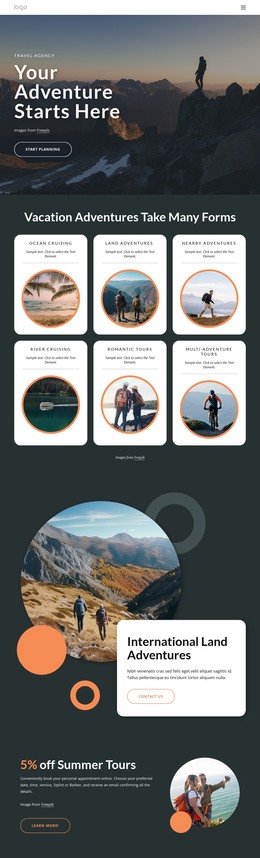
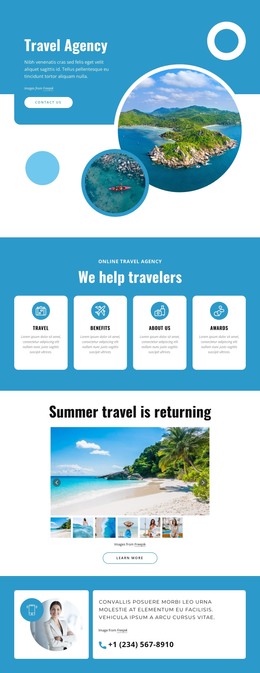
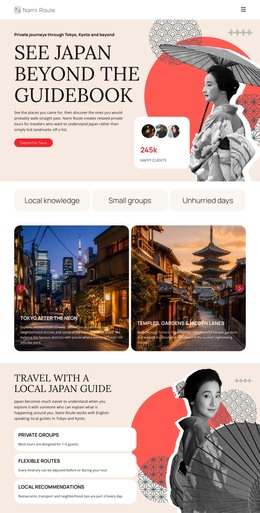
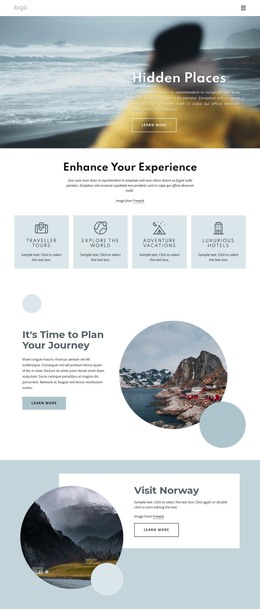
Imagine travelling to some of the most amazing places HTML Template

Edit Template Offline
2. Create new page and search for id 6069663
Edit Template Online
Create Awesome Websites


Free Nicepage Builder
Keywords
Nine Vacation Ideas Shape a Complete Static Travel Page
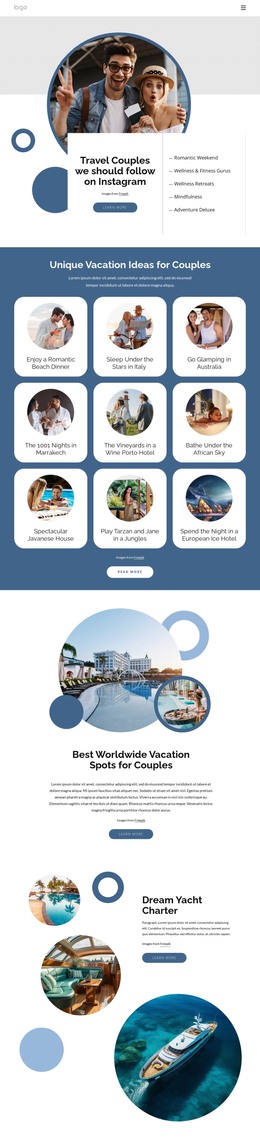
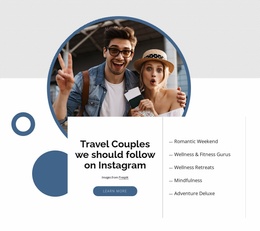
The opening introduction establishes the subject through travel photography, a centered message, a category list, and a learn-more action. From there, the page moves into a three-column collection of nine circular-image cards, including romantic beach dinners, sleeping under the stars in Italy, glamping in Australia, Marrakech, Porto, Africa, Java, and a European ice hotel. These cards give the static page a substantial content center instead of leaving the design as a simple hero with a single promotional message.
The later sections broaden that presentation with worldwide vacation spots, a Dream Yacht Charter feature, relaxing tours, and a four-image showcase titled “Romantic & Unique Vacations.” The repeated white panels, rounded imagery, generous spacing, and blue background create visual continuity while separating each travel idea into a readable content zone. A Book Now action introduces a clear booking point, and the closing contact area includes name, email, and message inputs above Facebook, Twitter, Instagram, and LinkedIn links. Together, these sections provide the content coverage expected from a finished standalone HTML page: introduction, ideas, destination features, visual proof, action, contact, and footer information.
Customize with Nicepage
Open this ready-made template in the HTML Builder and customize it visually in the Nicepage editor. Replace demo content, edit page sections, and adapt the design to your project without rebuilding the template from scratch.
Export and Use This Template as an HTML Website
Create a Portable HTML Website
When the template is ready, use the HTML Export option to create a static website with the files required for deployment. The exported website can be used independently of the Nicepage editor and deployed on your preferred hosting.
Nicepage also provides SEO settings and optimization features, including Page Titles and Descriptions, Canonical settings, headings, image Alt Text, and other page-level properties that help prepare the website for search engines.
Deploy Without a CMS
Upload the finished website to the hosting environment that fits your project. Because the exported site does not require WordPress, Joomla, or another CMS to deliver its pages, it can be placed on your own server, uploaded to a hosting provider, or deployed through an existing web infrastructure.
Hand Off the Website Files
The generated website files can also be provided to a client, developer, or hosting team. They remain available outside the Nicepage editor for deployment, technical review, or project-specific development when additional work is required.
This workflow makes the template a practical foundation for a portable static website that can be exported from the Nicepage editor and deployed independently.

Design Set (12)
-

-
-
-
-
-
-
Free Website Builder SoftwareDownload
-
-


More from Travel & Hotels HTML Templates
-
Free Website Builder SoftwareDownload