Music and entertainment top HTML Template


A Six-Topic Introduction Ready for a Static HTML Page
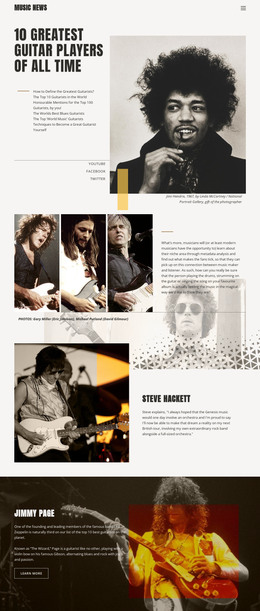
The heading, six-item topic list, portrait, and caption already form a focused editorial introduction that can be placed inside a static HTML page. The left side establishes the article subject and points toward related discussions, including defining great guitarists, world and blues guitarists, and techniques for becoming a better player. The right side balances that text with a monochrome portrait of Jimi Hendrix, while the caption identifies the 1967 image and its credited sources. Together, these regions give the section a recognizable purpose without requiring additional content to explain its subject.
The two-column arrangement also makes the block practical to position between other static sections. A surrounding page can supply navigation, longer article material, or later content while this section carries the opening editorial context. The three social links—YouTube, Facebook, and Twitter—remain grouped below the text column, giving the block a small distribution-oriented detail without changing its primary role. Warm off-white space, dark charcoal typography, and generous separation preserve the magazine-like presentation when text or images are adapted. In a Nicepage project, the containing page can later be exported as a static HTML website, while this block remains one prepared section within that implementation.
Customize with Nicepage
Open this ready-made template in the HTML Builder and customize it visually in the Nicepage editor. Replace demo content, edit page sections, and adapt the design to your project without rebuilding the template from scratch.
Edit Template Offline
2. Create a new page or select existing
3. Click Add new block, search for id 58611 and click enter
Edit Template Online
Create Awesome Websites


Free Nicepage Builder
Keywords
Export and Use This Template as an HTML Website
Create a Portable HTML Website
When the template is ready, use the HTML Export option to create a static website with the files required for deployment. The exported website can be used independently of the Nicepage editor and deployed on your preferred hosting.
Nicepage also provides SEO settings and optimization features, including Page Titles and Descriptions, Canonical settings, headings, image Alt Text, and other page-level properties that help prepare the website for search engines.
Deploy Without a CMS
Upload the finished website to the hosting environment that fits your project. Because the exported site does not require WordPress, Joomla, or another CMS to deliver its pages, it can be placed on your own server, uploaded to a hosting provider, or deployed through an existing web infrastructure.
Hand Off the Website Files
The generated website files can also be provided to a client, developer, or hosting team. They remain available outside the Nicepage editor for deployment, technical review, or project-specific development when additional work is required.
This workflow makes the template a practical foundation for a portable static website that can be exported from the Nicepage editor and deployed independently.




More from Music & Entertainment Blocks
-
-

-
-
-
-
-
-
-
-
-
Free Website Builder SoftwareDownload
-
-
-
-
-
-
-
-
-
-













More from Grid Blocks
-
-
-
-
-
-
-
-
-
-
-
Free Website Builder SoftwareDownload
-
-
-
-
-
-
-
-
-
-