Make safe sustainable seafood choices HTML Template


A Marine Image and Text Panel Form One Static Section
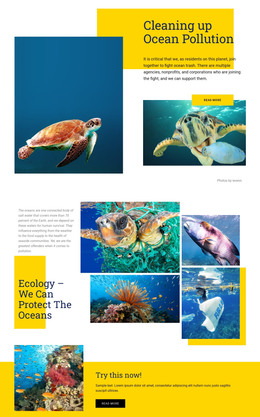
The section already combines the essential parts of a focused introductory message: a prominent heading, one explanatory paragraph, and a full-width underwater image containing multiple fish. The wording addresses depleted fish populations, habitat loss, and unsustainable fishing, then connects those issues with choosing seafood that is both healthful and sustainable. This gives the block a defined informational purpose without requiring additional sections to explain what its central topic is.
In a static HTML page, the translucent yellow panel provides a ready-made content area for the heading and paragraph, while the bright blue marine image carries the surrounding visual setting. The dark text remains distinct from the colorful underwater scene because the panel creates a separate contrast layer. The left alignment also gives the section an immediate reading path: visitors encounter the subject in the heading, then move into the supporting environmental explanation.
The block can therefore sit inside a broader static page as an introductory section for education, guidance, or nature-focused content. Other sections may provide detailed species information, resources, or navigation, but this reusable area can perform its own opening communication. Its prepared text-over-image arrangement reduces the need to invent a separate content structure while keeping the block limited to one clear subject and visual composition.
Customize with Nicepage
Open this ready-made template in the HTML Builder and customize it visually in the Nicepage editor. Replace demo content, edit page sections, and adapt the design to your project without rebuilding the template from scratch.
Edit Template Offline
2. Create a new page or select existing
3. Click Add new block, search for id 43923 and click enter
Edit Template Online
Create Awesome Websites


Free Nicepage Builder
Keywords
Export and Use This Template as an HTML Website
Create a Portable HTML Website
When the template is ready, use the HTML Export option to create a static website with the files required for deployment. The exported website can be used independently of the Nicepage editor and deployed on your preferred hosting.
Nicepage also provides SEO settings and optimization features, including Page Titles and Descriptions, Canonical settings, headings, image Alt Text, and other page-level properties that help prepare the website for search engines.
Deploy Without a CMS
Upload the finished website to the hosting environment that fits your project. Because the exported site does not require WordPress, Joomla, or another CMS to deliver its pages, it can be placed on your own server, uploaded to a hosting provider, or deployed through an existing web infrastructure.
Hand Off the Website Files
The generated website files can also be provided to a client, developer, or hosting team. They remain available outside the Nicepage editor for deployment, technical review, or project-specific development when additional work is required.
This workflow makes the template a practical foundation for a portable static website that can be exported from the Nicepage editor and deployed independently.