Whale watching center HTML Template

Edit Template Offline
2. Create new page and search for id 12805
Edit Template Online
Create Awesome Websites


Free Nicepage Builder
Keywords
A Complete Whale Article From Opening Image to Related Stories
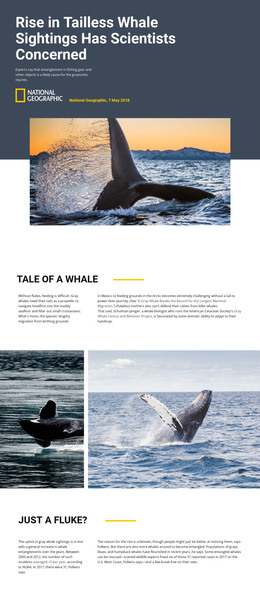
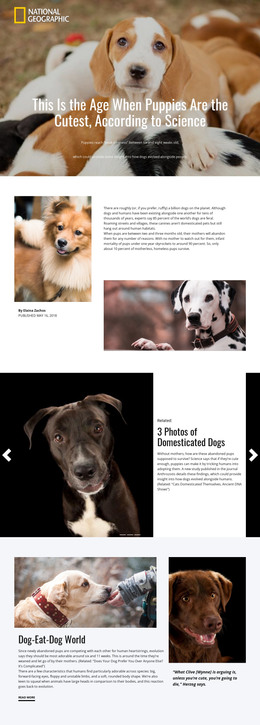
The page already brings together the major parts of a self-contained static article: an introductory hero, source information, explanatory text, supporting photography, evidence-focused discussion, and related reading. The opening headline about tailless whale sightings establishes the subject immediately, while the National Geographic attribution gives the report a defined editorial context. The following split section adds background on feeding behavior, migration from Mexico to the Arctic, and the protection of calves.
The second split section changes the emphasis from natural behavior to fishing-gear entanglement, reported incidents, possible causes, and rescue outcomes. Because the two passages are separated by a wide photographic interlude, the page can sustain a long-form reading experience without presenting one uninterrupted wall of text. The final grid of three story cards extends the subject through image-and-caption links to other wildlife articles.
That combination makes the design useful as a standalone HTML implementation rather than only a visual concept. Its content arrangement already supports an article with a beginning, explanatory middle, evidence-based development, and a related-reading conclusion. The visual system also remains coherent across the hero, text columns, photographs, and cards, so replacement copy and imagery can be introduced without rebuilding the page’s essential editorial roles.
Customize with Nicepage
Open this ready-made template in the HTML Builder and customize it visually in the Nicepage editor. Replace demo content, edit page sections, and adapt the design to your project without rebuilding the template from scratch.
Export and Use This Template as an HTML Website
Create a Portable HTML Website
When the template is ready, use the HTML Export option to create a static website with the files required for deployment. The exported website can be used independently of the Nicepage editor and deployed on your preferred hosting.
Nicepage also provides SEO settings and optimization features, including Page Titles and Descriptions, Canonical settings, headings, image Alt Text, and other page-level properties that help prepare the website for search engines.
Deploy Without a CMS
Upload the finished website to the hosting environment that fits your project. Because the exported site does not require WordPress, Joomla, or another CMS to deliver its pages, it can be placed on your own server, uploaded to a hosting provider, or deployed through an existing web infrastructure.
Hand Off the Website Files
The generated website files can also be provided to a client, developer, or hosting team. They remain available outside the Nicepage editor for deployment, technical review, or project-specific development when additional work is required.
This workflow makes the template a practical foundation for a portable static website that can be exported from the Nicepage editor and deployed independently.

More from Nature HTML Templates
-
Free Website Builder SoftwareDownload