Each of us has the power WordPress Theme


Heading-and-Paragraph Rows Suit Stable WordPress Page Content
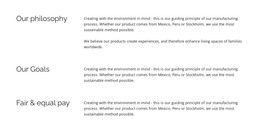
The content reads as enduring organizational information rather than a sequence of changing announcements. Three headings—“Our philosophy,” “Our Goals,” and “Fair & equal pay”—provide stable labels, and each is paired with explanatory copy in the adjacent column. The references to Mexico, Peru, and Stockholm add contextual detail to the text, while the philosophy row contains a second paragraph about products enhancing family living spaces. Because the block is static, visitors read the values in order without needing to operate a slider, tab set, or accordion.
For a WordPress-managed page, this structure can function as a permanent values section that remains visually consistent while other site content develops around it. The repeated two-column rows make the content straightforward to maintain as related heading-and-description units, without turning the section into a complete theme or site structure. The white background and black text contrast keep attention on the words, while generous vertical spacing separates the three principles and the clean sans-serif typography maintains a consistent reading rhythm. Other page areas can provide imagery, navigation, or detailed product content; this block can retain the focused values message.
Customize with Nicepage
Open this ready-made template in the WordPress Website Builder and customize it visually in the Nicepage editor. Replace demo content, edit page sections, and adapt the design to your project without rebuilding the template from scratch.
Edit Template Offline
2. Create a new page or select existing
3. Click Add new block, search for id 6182770 and click enter
Edit Template Online
Create Awesome Websites


Free Nicepage Builder
Keywords
Use This Block in a WordPress-Managed Website
Keep the Block as Page Content
Use the block as one content/layout section inside a WordPress-oriented site rather than treating the Block ID as a complete WordPress Theme. Its verified text, images, repeated items, forms, galleries, or other elements can remain part of permanent page content while WordPress manages the wider site.
Work With Nicepage and WordPress
A Nicepage WordPress project can be installed using the WordPress Theme, Plugin, and Pages workflow. After installation, the same visual section can participate in WordPress-managed pages as part of the broader theme/site structure.
Continue Editing in WordPress
Nicepage supports editing the WordPress Theme directly in WordPress. Use WordPress Pages, Posts, Blog structures, and other CMS concepts only when they are relevant to the surrounding project; their existence must not be inferred from the analyzed block alone.
This workflow keeps the block's verified section function separate from the WordPress theme architecture while allowing it to participate in a CMS-managed website.