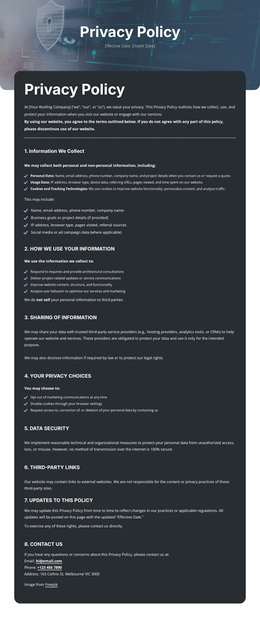
Your trust, our responsibility Template
Edit Template Offline
2. Create new page and search for id 6543910
Edit Template Online
Create Awesome Websites


Free Nicepage Builder
Keywords
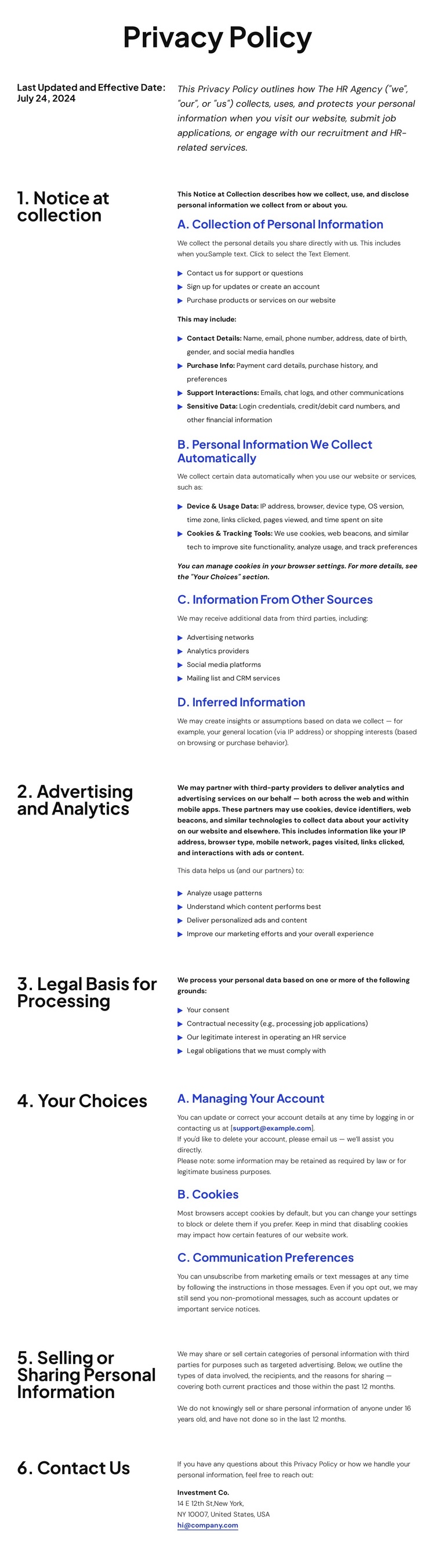
A Two-Column Policy Design for Detailed Rights Content
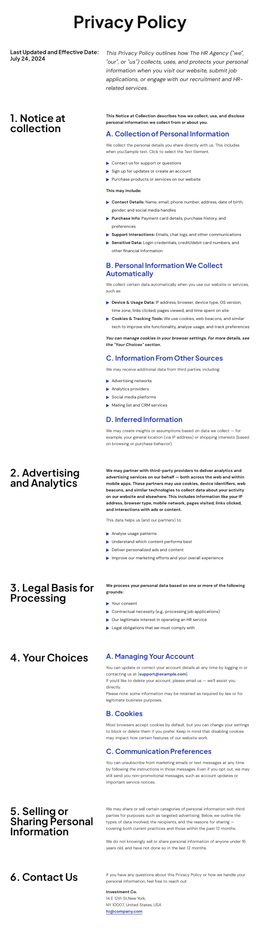
The strongest reason to choose this design is its focused coverage of the subjects a privacy document must keep distinct. Collection practices are separated from advertising and analytics, legal grounds, user choices, sharing disclosures, and rights, so readers can identify the policy topic they need without navigating an unrelated promotional layout. The rights section adds further depth through provisions for U.S. residents, request procedures, appeals, authorized agents, and California disclosure. Together, these areas make the design suited to organizations that need substantial explanatory text rather than a short notice.
Its repeated two-column structure gives that volume of content a consistent visual logic. Section titles remain visible on the left, while the right side carries paragraphs, subsections, and bullet lists; generous vertical spacing prevents the document from becoming a single dense text wall. The blue markers add restrained emphasis, and the dark footer provides a contrasting conclusion with help links, social links, address, email, and telephone channels. A compact header and search control keep the page connected to the wider website. The template is therefore a useful option when legal information, user controls, regional rights, and a final inquiry route must coexist in one readable presentation. However, the supplied analysis identifies conflicting organization and email references, and visible contact values include placeholders, so those details need verification before this design is adopted as a live policy.
Customize with Nicepage
Open this ready-made template in the Template Builder and customize it visually in the Nicepage editor. Replace demo content, edit page sections, and adapt the design to your project without rebuilding the template from scratch.
Start With a Ready-Made Template
Choose a Design for a New Page
Use a ready-made template as a starting point instead of creating every page from a blank canvas. When adding a new page in Nicepage, browse available designs, compare different layouts, and choose an option that already fits the general purpose and visual direction of your project.
Browse Different Page Designs
Explore Page Designs using search, thematic categories, Design Sets, and full-page previews. The collection includes layouts for different subjects and page purposes, making it easier to compare alternatives before selecting a design to customize.
Customize the Selected Template
After choosing a design, create the page and continue editing it visually in Nicepage. Replace the demo content, adjust images, typography, colors, sections, and other elements, and adapt the ready-made layout to your own content instead of rebuilding the design from the beginning.
Explore More Design Directions
If the first option does not match your project closely enough, return to the design collection and compare other templates before committing to a layout. This makes the template library useful not only for faster page creation, but also for exploring different visual approaches and finding a suitable starting point for a new project.
This workflow gives you access to a broad collection of ready-made designs that can be selected, compared, and customized according to the needs of each new page or project.