Pixel Perfect Every Time Website Template
Edit Template Offline
2. Create new page and search for id 6542433
Edit Template Online
Create Awesome Websites


Free Nicepage Builder
Keywords
Services, Project Evidence, and Contact Content Establish a Site Foundation
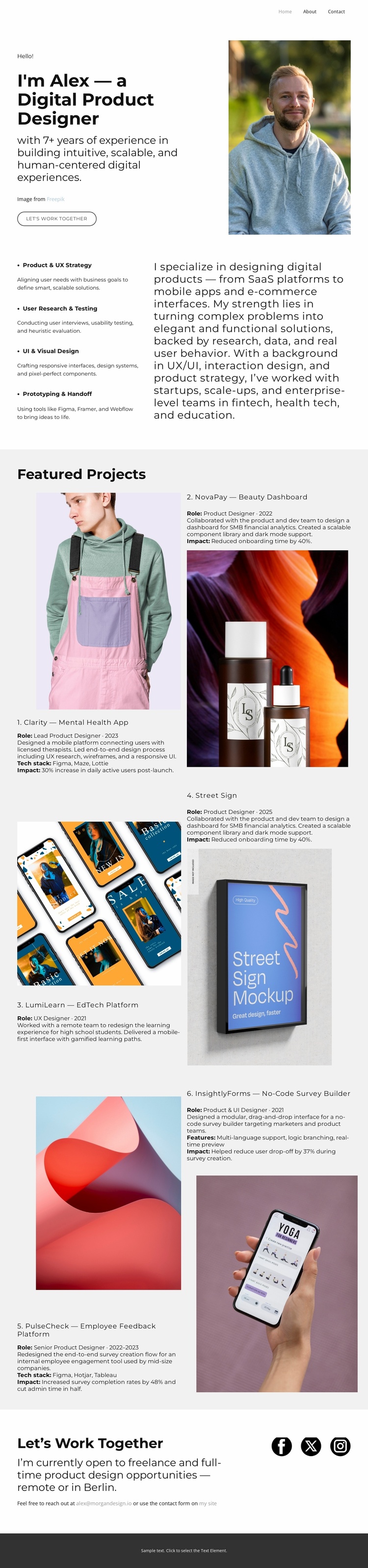
The page defines several major content areas that can serve as the starting information architecture for a broader design portfolio. The opening personal section supplies the site’s professional context through Alex’s name, digital product designer role, portrait, experience summary, and work-together action. It can anchor a home or profile-focused page without requiring the visitor to interpret the project gallery first. The next section separates four recurring service categories—Product and UX Strategy, User Research and Testing, UI and Visual Design, and Prototyping and Handoff—giving a larger site clear subjects for more detailed content if the project expands.
The six featured projects provide a second foundation: a portfolio area that could lead to individual case-study content while preserving the established relationship between imagery, numbered order, and project description. The visual variety across portrait, product, mobile-interface, and abstract imagery gives the design a flexible basis for different types of work, while the monochrome treatment can connect related pages visually.
The final freelance invitation, direct email line, and social-profile links create a defined contact region rather than leaving communication implicit. A broader website could develop separate service or project information around these existing areas, but the verified design itself should be treated as a strong starting page—not as evidence that additional pages already exist. The narrow dark footer provides a shared closing element for that potential expansion.
Customize with Nicepage
Open this ready-made template in the Website Template Builder and customize it visually in the Nicepage editor. Replace demo content, edit page sections, and adapt the design to your project without rebuilding the template from scratch.
Build a Complete Website From This Template
Customize the Website Visually
Use this ready-made website template as a starting point for your project and adapt its pages visually in Nicepage. Change content, images, typography, navigation, sections, and other design elements while keeping the website together as a single editable project.
Manage Website Pages in One Project
Use the Pages panel to open, add, duplicate, and manage the pages of your website. Work on individual pages while keeping navigation and the overall site structure accessible from the same project, making it easier to develop a complete website instead of managing separate page files.
Expand the Website With Matching Designs
When you need additional pages or sections, use Page Design Sets to find Page and Block Designs created in the same visual style. Design Sets group matching designs together, making it easier to expand the website with new content while maintaining a consistent look across its pages and sections.
Organize Larger Multi-Page Websites
As the website grows, use Page Folders to organize related pages and keep larger multi-page projects easier to navigate in the editor. This is especially useful for websites with separate service pages, company information, contacts, landing pages, and other content areas.
This workflow makes the template a practical foundation for building and expanding a complete website while managing its pages, content, and visual design within one Nicepage project.