Sales manager Website Template


A Compact Resume Profile for a Broader Website Project
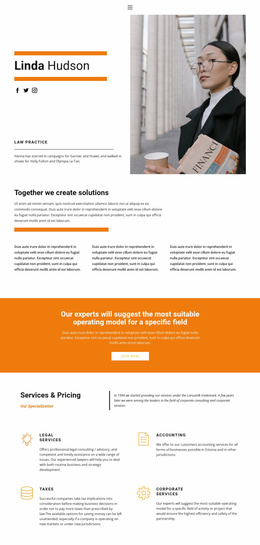
The portrait and the “My Resume” heading establish the block as a personal introduction, while the profile name and descriptive paragraph provide the identifying and explanatory content that follows. Three social media icons sit beneath the paragraph as a compact connection area. This sequence gives the section a stable role: it introduces one person first, explains the profile second, and offers external social destinations last.
Within a broader website project, the block can serve as a reusable profile section on a resume, portfolio, team, or professional presentation page. Other sections can handle detailed experience, projects, services, or contact information without forcing this compact arrangement to cover those functions. Its value as a site section comes from the fact that the image, identity, copy, and social links already work together as one recognizable content area.
The visual treatment supports reuse as well. Black typography contrasts with the light neutral background, while pale pink and beige shapes and thin gray curved outlines add a consistent decorative layer around the portrait-and-text composition. A project can echo those visual cues in related sections while keeping this block’s personal introduction distinct. The result is a defined website section, not a complete site structure, that can be coordinated with other pages and blocks.
Customize with Nicepage
Open this ready-made template in the Website Template Builder and customize it visually in the Nicepage editor. Replace demo content, edit page sections, and adapt the design to your project without rebuilding the template from scratch.
Edit Template Offline
2. Create a new page or select existing
3. Click Add new block, search for id 444623 and click enter
Edit Template Online
Create Awesome Websites


Free Nicepage Builder
Keywords
Build a Complete Website From This Template
Customize the Website Visually
Use this ready-made website template as a starting point for your project and adapt its pages visually in Nicepage. Change content, images, typography, navigation, sections, and other design elements while keeping the website together as a single editable project.
Manage Website Pages in One Project
Use the Pages panel to open, add, duplicate, and manage the pages of your website. Work on individual pages while keeping navigation and the overall site structure accessible from the same project, making it easier to develop a complete website instead of managing separate page files.
Expand the Website With Matching Designs
When you need additional pages or sections, use Page Design Sets to find Page and Block Designs created in the same visual style. Design Sets group matching designs together, making it easier to expand the website with new content while maintaining a consistent look across its pages and sections.
Organize Larger Multi-Page Websites
As the website grows, use Page Folders to organize related pages and keep larger multi-page projects easier to navigate in the editor. This is especially useful for websites with separate service pages, company information, contacts, landing pages, and other content areas.
This workflow makes the template a practical foundation for building and expanding a complete website while managing its pages, content, and visual design within one Nicepage project.