Modern Perfume Boutique CSS Template


Edit Template Offline
2. Create new page and search for id 6622736
Edit Template Online
Create Awesome Websites


Free Nicepage Builder
Keywords
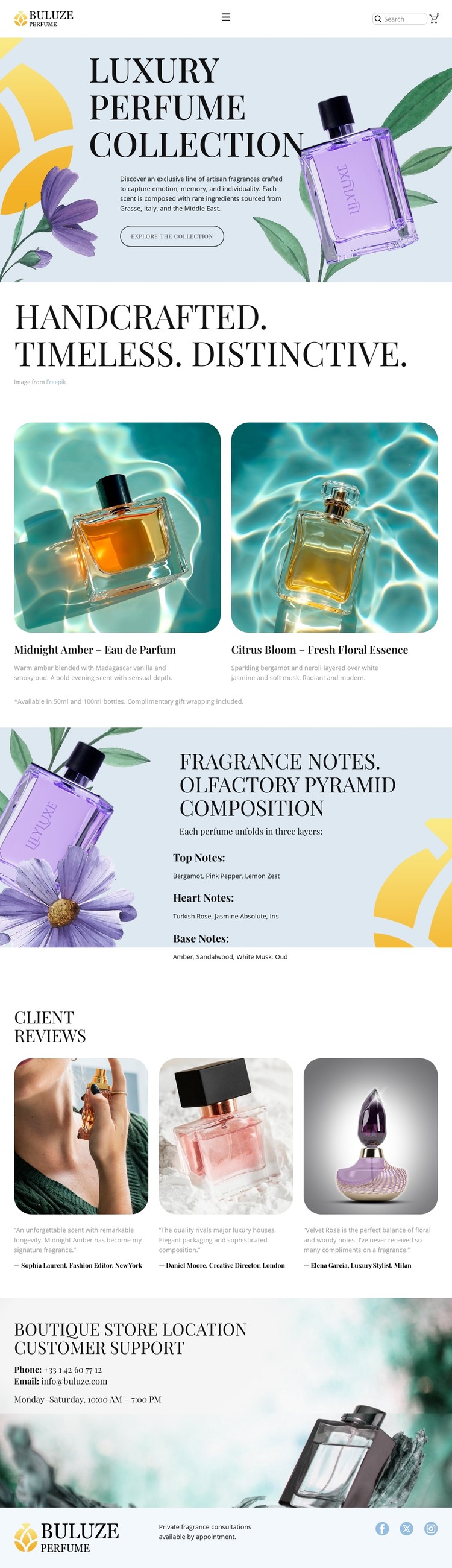
Powder-Blue Surfaces and Botanical Imagery Define the Style System
The page’s visual character comes from the relationship between its soft powder-blue and cream surfaces and the highly detailed perfume photography. Pale blue backgrounds give the hero and fragrance-note section a calm field, while bottles, flowers, leaves, and water textures provide the visual focus. This contrast lets the product images carry attention without requiring heavy decoration.
Editorial serif typography gives the collection heading and section titles a luxury-oriented presence, while restrained sans-serif text supports descriptions, note explanations, reviews, and contact information. The two equal product cards repeat the same visual logic, creating a consistent presentation for Midnight Amber and Citrus Bloom rather than treating each product as an unrelated composition. Lavender, yellow, and botanical green accents extend the palette into the imagery and supporting details. These recurring relationships make the page suitable for styling work focused on backgrounds, type hierarchy, spacing, card treatment, image scale, and contrast. The atmospheric support area and light footer continue the same restrained treatment through the closing sections. The result is a recognizable boutique appearance whose individual colors, borders, spacing, and visual accents can be refined without changing the underlying content sequence.
Customize with Nicepage
Open this ready-made template in the CSS Template Builder and customize it visually in the Nicepage editor. Replace demo content, edit page sections, and adapt the design to your project without rebuilding the template from scratch.
Customize This Template With CSS
Control Page-Specific Styling
Customize the visual appearance of this ready-made template directly in the Nicepage editor. Adjust typography, spacing, backgrounds, borders, colors, positioning, and other style properties using visual controls while keeping the page layout easy to manage without writing CSS manually.
Add Custom CSS When Needed
For styling requirements that go beyond the standard editor options, use Custom CSS to add targeted rules. CSS can be applied to individual elements, specific pages, or the entire website depending on the scope of the customization, while CSS classes can be used to connect custom rules with selected elements.
Export Minimal CSS Per Page
For projects where CSS size and page performance matter, Nicepage can export minimal CSS for each page. Instead of relying on one larger common stylesheet, each page can use a separate CSS file containing only the style rules required for that particular page. According to Nicepage documentation, these page-specific CSS files can be about ten times more compact, helping reduce unnecessary CSS and improve page loading performance.
This workflow combines visual styling with optional custom CSS and optimized page-specific CSS output, giving you additional control when a project requires it without making manual CSS editing the primary way to customize the template.