
Ready, Set, Guess CSS Template


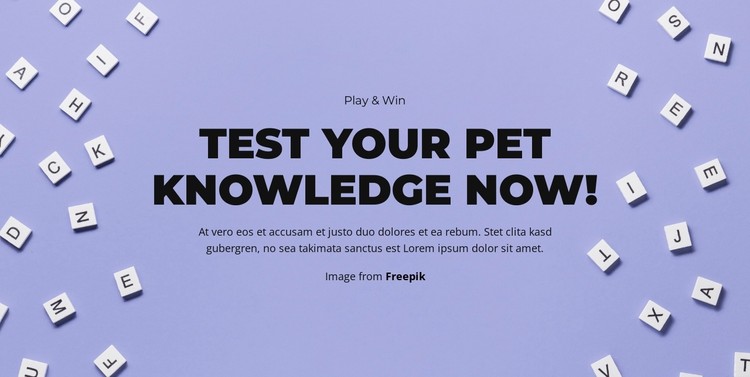
Letter Tiles Frame the Central Quiz Message
The lavender-blue background and scattered letter tiles establish the block’s main visual treatment before the visitor reaches the centered text. Because the decorative elements stay around the edges, they create atmosphere without competing with the small “Play & Win” label, the bold “Test Your Pet Knowledge Now!” heading, or the supporting paragraph below it. The open center is therefore as important to the styling as the backdrop itself: it preserves contrast and gives the hierarchy room to breathe.
For a CSS Template interpretation, the useful styling relationships are contained inside this one hero section. The background treatment can remain visually distinctive while typography, alignment, spacing, and contrast are refined around the existing quiz message. The eyebrow, heading, and paragraph should continue to read as one vertical group rather than as separate floating items. Adjustments to the letter-tile placement, image treatment, or surrounding space can change emphasis without altering the section’s introductory content.
The result is a focused style system for a static hero: decorative background energy at the perimeter, strong black type in the center, and generous separation between the text levels. It can introduce a pet quiz while retaining a controlled appearance within the larger page.
Customize with Nicepage
Open this ready-made template in the CSS Template Builder and customize it visually in the Nicepage editor. Replace demo content, edit page sections, and adapt the design to your project without rebuilding the template from scratch.
Edit Template Offline
2. Create a new page or select existing
3. Click Add new block, search for id 6539433 and click enter
Edit Template Online
Create Awesome Websites


Free Nicepage Builder
Keywords
Customize This Template With CSS
Control Page-Specific Styling
Customize the visual appearance of this ready-made template directly in the Nicepage editor. Adjust typography, spacing, backgrounds, borders, colors, positioning, and other style properties using visual controls while keeping the page layout easy to manage without writing CSS manually.
Add Custom CSS When Needed
For styling requirements that go beyond the standard editor options, use Custom CSS to add targeted rules. CSS can be applied to individual elements, specific pages, or the entire website depending on the scope of the customization, while CSS classes can be used to connect custom rules with selected elements.
Export Minimal CSS Per Page
For projects where CSS size and page performance matter, Nicepage can export minimal CSS for each page. Instead of relying on one larger common stylesheet, each page can use a separate CSS file containing only the style rules required for that particular page. According to Nicepage documentation, these page-specific CSS files can be about ten times more compact, helping reduce unnecessary CSS and improve page loading performance.
This workflow combines visual styling with optional custom CSS and optimized page-specific CSS output, giving you additional control when a project requires it without making manual CSS editing the primary way to customize the template.