We are leaders in industrial business CSS Template


Edit Template Offline
2. Create new page and search for id 6011097
Edit Template Online
Create Awesome Websites


Free Nicepage Builder
Keywords
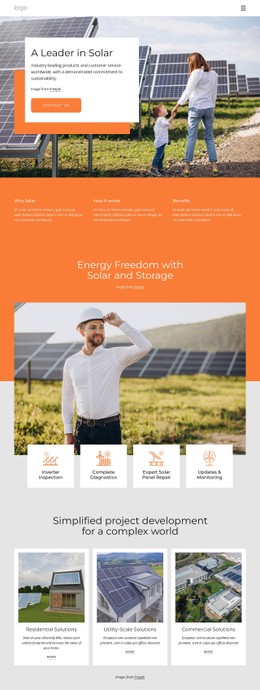
Dark Overlays and Repeated White Cards Shape the Solar Styling System
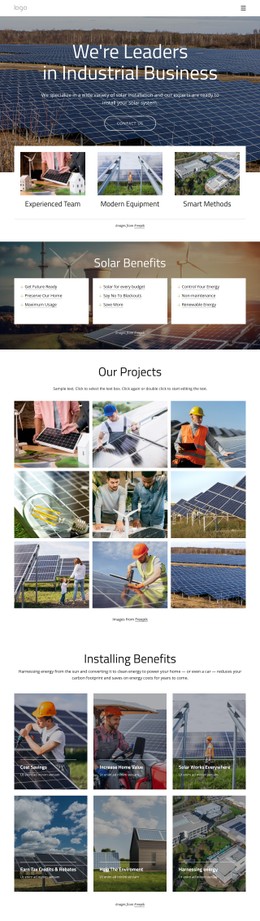
The page’s styling depends on a controlled contrast between large renewable-energy images, dark charcoal overlays, white content cards, and blue accents. In the hero, centered sans-serif typography sits over a prominent image, with the Contact Us button acting as a focused visual accent. The three supporting cards below repeat a common treatment for Experienced Team, Modern Equipment, and Smart Methods, giving separate content items a shared appearance rather than making each one look unrelated.
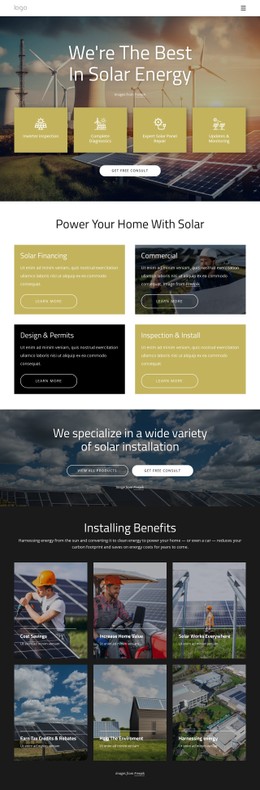
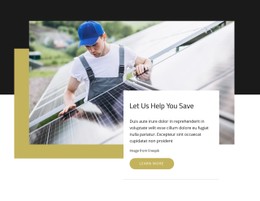
That visual rule continues in the Solar Benefits section, where three white cards are placed over a dark photographic background. The lighter surfaces create readable content zones for grouped ideas such as energy control, savings, renewable energy, and avoiding blackouts, while the image remains visible as context. The nine-image Our Projects gallery changes the styling rhythm from layered cards to a regular three-column image arrangement. Six image-backed Installing Benefits cards then return to a repeated image-and-text treatment, connecting cost savings, home value, tax credits and rebates, environmental support, and harnessing energy through consistent visual formatting.
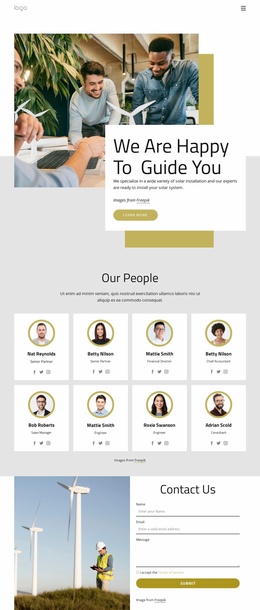
Generous spacing and centered alignment prevent the many repeated units from becoming visually crowded. The contact area applies the same contrast logic by pairing an energy image with a light form region, while the dark footer reinforces the deeper tones used elsewhere. These relationships give the design concrete styling rules that can be adjusted while preserving its recognizable solar presentation.
Customize with Nicepage
Open this ready-made template in the CSS Template Builder and customize it visually in the Nicepage editor. Replace demo content, edit page sections, and adapt the design to your project without rebuilding the template from scratch.
Customize This Template With CSS
Control Page-Specific Styling
Customize the visual appearance of this ready-made template directly in the Nicepage editor. Adjust typography, spacing, backgrounds, borders, colors, positioning, and other style properties using visual controls while keeping the page layout easy to manage without writing CSS manually.
Add Custom CSS When Needed
For styling requirements that go beyond the standard editor options, use Custom CSS to add targeted rules. CSS can be applied to individual elements, specific pages, or the entire website depending on the scope of the customization, while CSS classes can be used to connect custom rules with selected elements.
Export Minimal CSS Per Page
For projects where CSS size and page performance matter, Nicepage can export minimal CSS for each page. Instead of relying on one larger common stylesheet, each page can use a separate CSS file containing only the style rules required for that particular page. According to Nicepage documentation, these page-specific CSS files can be about ten times more compact, helping reduce unnecessary CSS and improve page loading performance.
This workflow combines visual styling with optional custom CSS and optimized page-specific CSS output, giving you additional control when a project requires it without making manual CSS editing the primary way to customize the template.