Find the perfect place CSS Template


Edit Template Offline
2. Create new page and search for id 4480779
Edit Template Online
Create Awesome Websites


Free Nicepage Builder
Keywords
Rounded Cards and Orange Accents Shape the Property Styling System
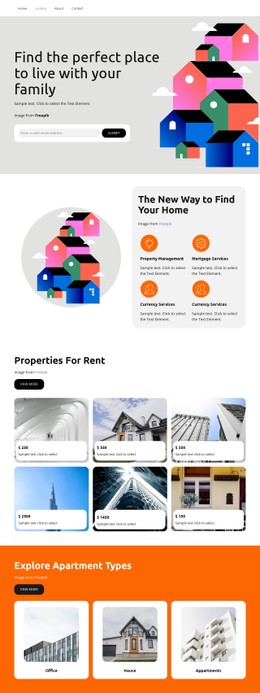
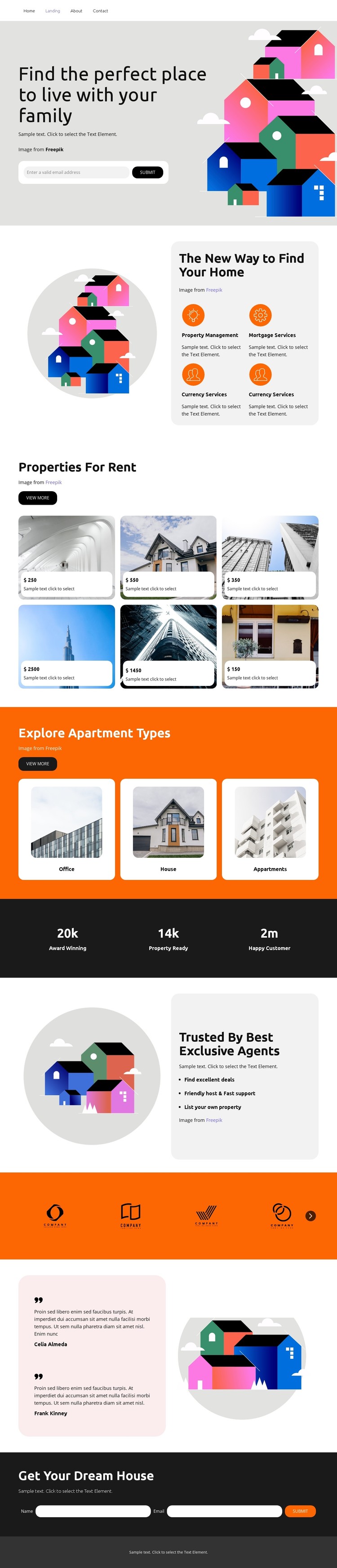
The warm orange and charcoal palette gives this property page a clear contrast system. Orange appears in prominent horizontal areas, including the partner-logo strip, while charcoal is used for the counter band, closing inquiry section, and footer. White and pale gray surfaces then create calmer areas for service content and testimonials. This alternation separates emphasis from supporting information without requiring a different visual treatment for every section.
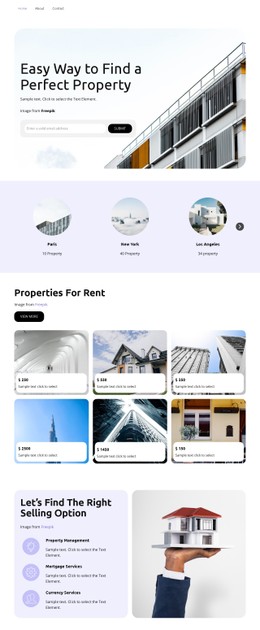
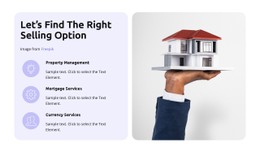
Rounded cards are especially important in the property listings and apartment categories. The six rental cards use image-led surfaces with price labels, while the three apartment-type cards repeat a related visual rhythm for Office, House, and Appartments. Their shared treatment connects individual listings with broader categories, yet the different group sizes preserve a visible content distinction. Circular illustrations and softly curved image treatments reinforce the residential subject and soften the stronger dark and orange blocks.
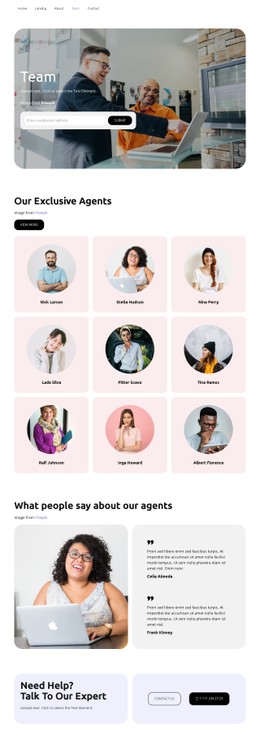
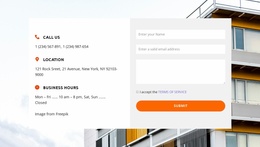
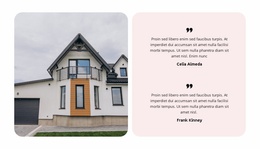
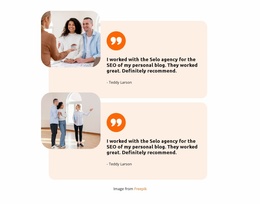
Compact sans-serif typography, spacious section padding, and strong contrast support the hierarchy from the family-focused hero to the final contact form. The service panel, agent section, and testimonial area can retain the same spacing and surface logic so the page feels coordinated rather than assembled from unrelated parts. For projects needing a more tailored visual implementation, Nicepage supports Custom CSS for extending the styling of individual elements, the page, or the website.
Customize with Nicepage
Open this ready-made template in the CSS Template Builder and customize it visually in the Nicepage editor. Replace demo content, edit page sections, and adapt the design to your project without rebuilding the template from scratch.
Customize This Template With CSS
Control Page-Specific Styling
Customize the visual appearance of this ready-made template directly in the Nicepage editor. Adjust typography, spacing, backgrounds, borders, colors, positioning, and other style properties using visual controls while keeping the page layout easy to manage without writing CSS manually.
Add Custom CSS When Needed
For styling requirements that go beyond the standard editor options, use Custom CSS to add targeted rules. CSS can be applied to individual elements, specific pages, or the entire website depending on the scope of the customization, while CSS classes can be used to connect custom rules with selected elements.
Export Minimal CSS Per Page
For projects where CSS size and page performance matter, Nicepage can export minimal CSS for each page. Instead of relying on one larger common stylesheet, each page can use a separate CSS file containing only the style rules required for that particular page. According to Nicepage documentation, these page-specific CSS files can be about ten times more compact, helping reduce unnecessary CSS and improve page loading performance.
This workflow combines visual styling with optional custom CSS and optimized page-specific CSS output, giving you additional control when a project requires it without making manual CSS editing the primary way to customize the template.