Losing weight CSS Template



Edit Template Offline
2. Create new page and search for id 1804843
Edit Template Online
Create Awesome Websites


Free Nicepage Builder
Keywords
Rounded Topic Cards Build a Reusable Styling System
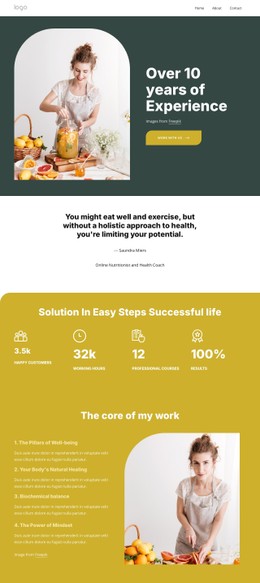
The four rounded topic cards establish the clearest repeated styling rule in the page. Each combines an icon, a short health-related label, and supporting text inside a peer-level card structure, allowing the visual treatment to connect Healthy Weight, Eating Healthy, Psychology, and Activity without making them look like unrelated panels. That same card logic continues in the nutrition-plan section, where two supporting cards sit beside the introductory content.
The palette gives the page a strong visual sequence. Navy provides the deepest emphasis, while coral and orange create warmer focal areas for the program, challenge, and exercise content. White information cards and light-gray space prevent the image-led sections from becoming visually dense. Large lifestyle, meal, and exercise photographs add contrast against the solid color panels, while the circular image in the challenge section introduces a distinct geometric accent.
The split sections also show how appearance can guide hierarchy without changing the content order. Rounded white cards, colored text panels, compact headings, checklist styling, and repeated action links create a consistent visual vocabulary from the hero through the contact area. These properties make the design suitable for adjusting colors, spacing, borders, typography, image crops, and accents as a coordinated CSS-oriented styling system.
Customize with Nicepage
Open this ready-made template in the CSS Template Builder and customize it visually in the Nicepage editor. Replace demo content, edit page sections, and adapt the design to your project without rebuilding the template from scratch.
Customize This Template With CSS
Control Page-Specific Styling
Customize the visual appearance of this ready-made template directly in the Nicepage editor. Adjust typography, spacing, backgrounds, borders, colors, positioning, and other style properties using visual controls while keeping the page layout easy to manage without writing CSS manually.
Add Custom CSS When Needed
For styling requirements that go beyond the standard editor options, use Custom CSS to add targeted rules. CSS can be applied to individual elements, specific pages, or the entire website depending on the scope of the customization, while CSS classes can be used to connect custom rules with selected elements.
Export Minimal CSS Per Page
For projects where CSS size and page performance matter, Nicepage can export minimal CSS for each page. Instead of relying on one larger common stylesheet, each page can use a separate CSS file containing only the style rules required for that particular page. According to Nicepage documentation, these page-specific CSS files can be about ten times more compact, helping reduce unnecessary CSS and improve page loading performance.
This workflow combines visual styling with optional custom CSS and optimized page-specific CSS output, giving you additional control when a project requires it without making manual CSS editing the primary way to customize the template.