Disigners and developments One Page Template


A Distinct Team Destination in Continuous Page Flow
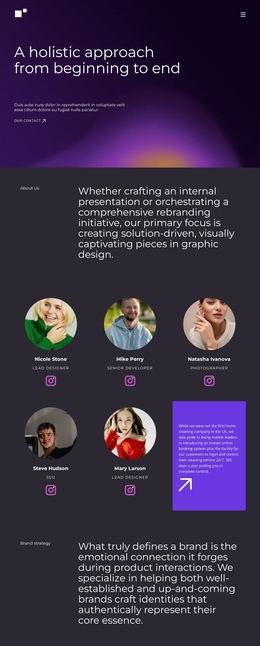
The statement about a team of makers, designers, and developers gives this block a clear subject that visitors can recognize as they move through a continuous page. The two-column panel reinforces that identity: the left side announces the section's theme, while the right side supplies supporting copy and five social media links for further exploration. Because the message and its supporting details are grouped within one white surface, the section can function as a meaningful content destination rather than a transitional fragment.
The abstract background also helps separate this destination from neighboring sections. Overlapping pink, purple, blue, orange, and yellow forms create a strong visual change, while the white panel preserves readability and keeps the heading visibly dominant. In a one-page layout, this block could follow an introduction and precede work samples, services, or contact content. That is a possible placement within the page flow, not a claim that navigation is already built into the section. If section-based navigation is added at the page level, the block's clear team subject gives visitors a logical destination to recognize. The social icons provide additional outward routes without replacing the continuous page journey. Its role is therefore informational and identity-building, with a visual boundary strong enough to distinguish it from adjacent content.
Customize with Nicepage
Open this ready-made template in the One Page Template Builder and customize it visually in the Nicepage editor. Replace demo content, edit page sections, and adapt the design to your project without rebuilding the template from scratch.
Edit Template Offline
2. Create a new page or select existing
3. Click Add new block, search for id 2176502 and click enter
Edit Template Online
Create Awesome Websites


Free Nicepage Builder
Keywords
Use This Block as a Section in a One-Page Website
Give the Block a Distinct Content Role
A one-page website combines several meaningful content sections within one continuous document. A block can serve as one of those destinations—for example About, Services, Gallery, Testimonials, Pricing, Team, or Contact—while other blocks provide the rest of the page journey.
Connect Navigation to Meaningful Sections
When the final page uses section-based navigation, Menu For One-Page Site can connect menu items to individual page Blocks. The analyzed block does not prove that anchor navigation already exists; it simply provides one possible destination when its content is substantial enough to stand as a recognizable section.
Keep Longer Pages Easy to Explore
For long one-page sites, Back To Top can help visitors return to the beginning after moving through several sections. Navigation behavior is managed at the page level, while each block retains its own content function.
This workflow positions the block as one part of a continuous one-page experience rather than treating a single section as the entire one-page site.