Bumble Space One Page Template


Edit Template Offline
2. Create new page and search for id 12818
Edit Template Online
Create Awesome Websites


Free Nicepage Builder
Keywords
Distinct Story Destinations Create a Continuous Editorial Journey
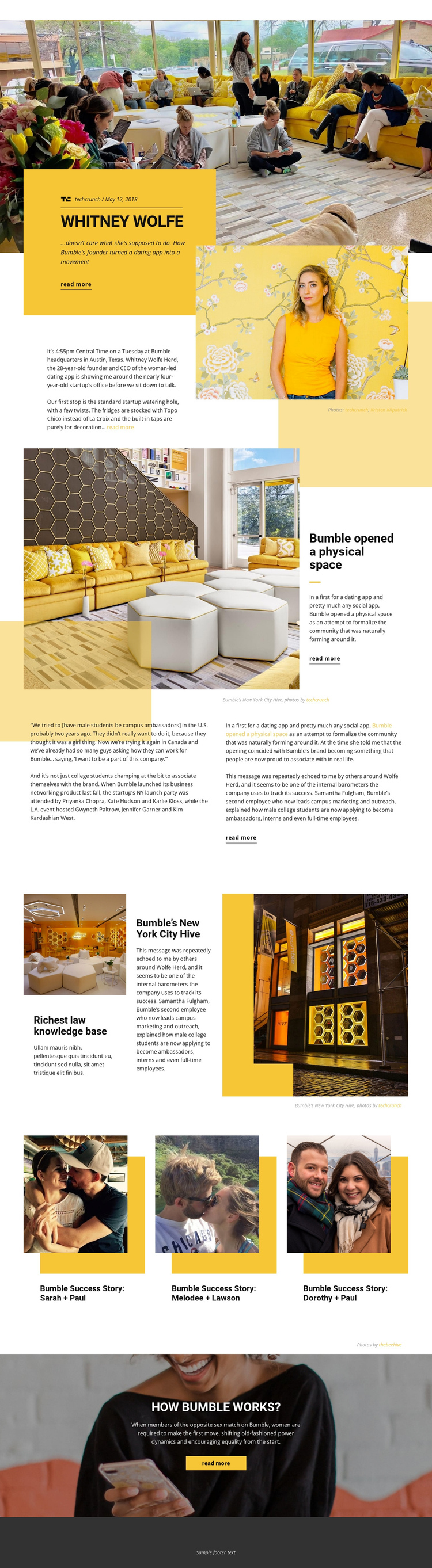
The page can be read as a sequence of separate information destinations rather than one undivided article. The opening photograph introduces the visual setting, after which the Whitney Wolfe section provides the founder profile. The next split section changes the focus to Bumble’s physical space in New York City, giving visitors a second subject to explore without leaving the page. Each section has its own heading, image relationship, and text role.
The supporting grid adds a denser editorial destination where excerpts, quoted passages, captions, and photographs are read together. It is followed by the “Bumble’s New York City Hive” content area and then by three related success-story cards, which offer a compact route into additional stories. The closing “HOW BUMBLE WORKS?” section serves as a final destination for understanding Bumble’s matching interaction, while the dark footer marks the end of the continuous document.
This arrangement suits a one-page content journey because the visitor moves through profile, place, supporting evidence, related stories, and product explanation in a deliberate order. The source confirms navigation elements, but not anchor links to every section, so the design should be described as suitable for section-based one-page organization rather than as proof that anchor navigation is already configured.
Customize with Nicepage
Open this ready-made template in the One Page Template Builder and customize it visually in the Nicepage editor. Replace demo content, edit page sections, and adapt the design to your project without rebuilding the template from scratch.
Build a Navigable One-Page Website
Connect the Menu to Page Sections
Organize the website as a sequence of sections on a single page and use the Menu For One-Page Site to connect menu items with individual page Blocks. Visitors can jump directly to sections such as About, Services, Testimonials, or Contact without opening separate pages.
Keep the Website on One URL
A one-page template can combine several parts of a small website within one continuous page. Arrange the Header, introduction, services, portfolio, company information, reviews, contact details, and other relevant sections in the order that fits the project while keeping them accessible through the same page navigation.
Make Long Pages Easier to Navigate
For longer one-page websites, keep navigation labels short and connected to meaningful sections so visitors can move through the page without relying only on scrolling. You can also use the Back To Top element to provide a quick way back to the beginning after longer sections.
This workflow makes the template suitable for compact websites that need several distinct content sections while keeping the complete visitor experience on one URL.