Hacker Developer Portfolio Landing Page

Edit Template Offline
2. Create new page and search for id 6629062
Edit Template Online
Create Awesome Websites


Free Nicepage Builder
Keywords
Testimonials and Security Services Build Toward Consultation
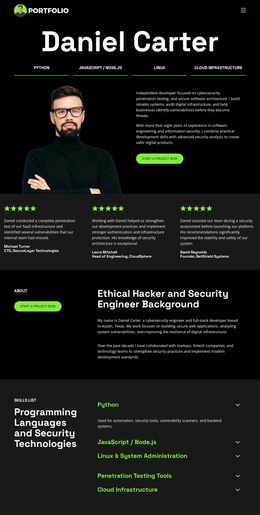
The portrait-led opening gives the page an identifiable expert and a direct reason to continue: Daniel Carter is introduced alongside a cybersecurity-focused contact action. The page does not leave the offer abstract. Its background section explains the featured professional, while the skills area names programming, infrastructure, and penetration-testing capabilities that support the service message.
The three service descriptions provide the central response context: penetration testing, security audits, and secure application development. Before visitors reach the final contact area, the row of three testimonial cards supplies a separate credibility layer, and the selected-work strip adds visual evidence of project activity. This sequence moves from person and expertise to services and supporting proof, making the later inquiry section feel connected to the information that precedes it.
The closing contact block is especially important for a landing-page interpretation because it offers direct office, email, and phone channels and is titled around contacting an ethical hacker for security consulting. The earlier “Get a free consultation” call to action can point toward that same response path, while secondary content remains subordinate to the consulting objective. The design therefore supports a focused campaign presentation without requiring invented pricing, claims, or additional conversion mechanisms.
Customize with Nicepage
Open this ready-made template in the Landing Page Builder and customize it visually in the Nicepage editor. Replace demo content, edit page sections, and adapt the design to your project without rebuilding the template from scratch.
Build a Landing Page Around One Conversion Goal
Focus on One Primary Action
Use the landing page to guide visitors toward one measurable response, such as requesting a quote, registering, subscribing, booking a consultation, applying for a service, or submitting an inquiry. Keep the primary call-to-action consistent across the important sections so the headline, supporting content, form, and CTA buttons work toward the same campaign goal instead of competing for attention.
Capture Leads With a Form
Use the Contact Form Element to add a contact, subscription, application, or other conversion form directly to the landing page. Customize the form fields, layout, labels, inputs, and button to collect the information required for your campaign while keeping the form focused on the action you want visitors to complete.
Nicepage also provides several form submission options. Form submissions can be sent to Email, stored as Leads, added to Google Sheets, passed to a custom URL or server endpoint, or used to populate a MailChimp mailing list. This provides practical options for collecting inquiries, registrations, subscriptions, applications, and other campaign responses.
Manage Leads and Campaign Responses
When submissions are stored as Leads, you can use Contact Form Leads to review the information collected through the landing page and use it for follow-up. Keep the form connected to the same offer and primary CTA presented throughout the page so visitors move from the campaign message to a clear conversion action.
This workflow makes the template suitable for landing pages where the offer, content, call-to-action, form, and lead collection process work together toward one defined conversion goal.

More from Technology Landing Pages
-
Free Website Builder SoftwareDownload